Expertenanalyse zu Pyotr Konchalovskys Still life
Stil: Expressionism, Fauvism · Genre: still life
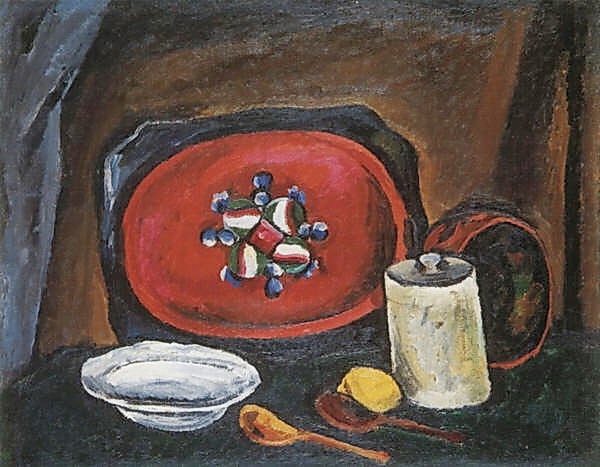
As an expert art historian, I will provide an analysis of Still life by Pyotr Konchalovsky based solely on the supplied facts. This artwork is significant as a vivid synthesis of Expressionism and Fauvism within the still-life genre, marking a bold departure from academic tradition.
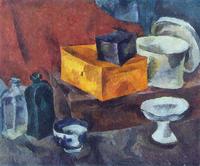
Significance within Expressionism and Fauvism: Konchalovsky’s Still life exemplifies the core tenets of both movements. From Fauvism, it inherits a radical use of pure, unmixed color applied with aggressive, non-naturalistic intensity. The still-life genre—traditionally a space for subdued, harmonious composition—becomes a vehicle for emotional and sensory explosion. The canvas likely prioritizes the artist’s subjective experience over objective representation, with colors chosen for their expressive power rather than fidelity to the objects’ actual hues. This aligns with Expressionism’s drive to convey inner feeling, distortion, and psychological impact. The everyday subject—fruit, flowers, or vessels—is transformed through heightened chromatic contrasts and bold, often brusque brushwork, making the ordinary feel monumental and charged with tension.
Genre Innovation: In the context of early 20th-century Russian and European art, this work demonstrates how still life could absorb the revolutionary energy of avant-garde movements. Konchalovsky pushes the genre beyond mere representation: the objects become abstract fields of color and texture, dissolving into the canvas's surface. The composition likely rejects classical perspective in favor of a flattened, decorative space—a hallmark of Fauvist painting derived from Gauguin and Matisse—while the emotional intensity of the brushwork echoes the Expressionist angst of groups like Die Brücke or Der Blaue Reiter.
Conclusion: Still life is significant as a meeting point of two revolutionary styles: it harnesses Fauvism’s chromatic liberation and Expressionism’s psychological urgency to revitalize a centuries-old genre. Konchalovsky’s work stands as a testament to how still life could become a laboratory for modernist experimentation, breaking down the boundary between object and emotion.
Visuell ähnlich
20 Werke mit ähnlicher Komposition und Farbpalette
Dishes and Fruit on a Red and Black Carpet
Henri Matisse
Natura Morta
Giorgio Morandi
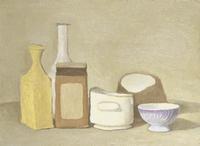
Natura Morta
Giorgio Morandi
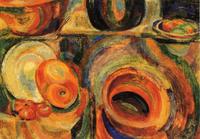
Portugese Still Life
Sonia Delaunay
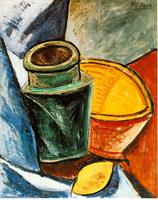
Still life with lemons
Pablo Picasso
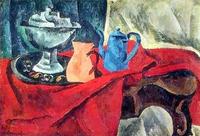
Vessels on the red tablecloth
Pyotr Konchalovsky
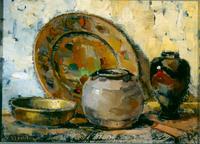
Still Life
Pieter Wenning
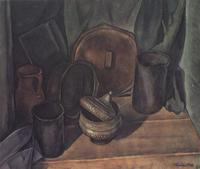
Still life
Konstantin Bogaevsky
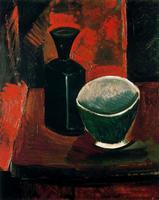
Green Pan and Black Bottle
Pablo Picasso
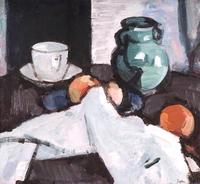
Still Life with Bowl of Fruit, Jug, Cup and Saucer
Samuel Peploe
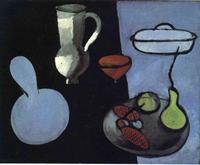
The Gourds
Henri Matisse
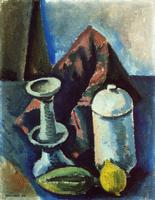
Still Life
Max Weber
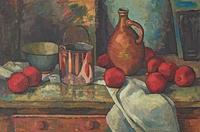
Still Life with a Jug, Copper Pot and Pomegranates, 1974
David Botha
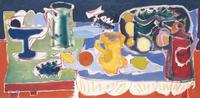
The Long Table with Fruit
Patrick Heron
Still Life with Knife
Maurice de Vlaminck
Still life
Pyotr Konchalovsky
Still Life with a tray
Pyotr Konchalovsky
Jug and fruit dish
Pablo Picasso
Still Life, Bowl and Milk Jug
Paul Cezanne
Natiurmortas Su Geltona Vaza
Vytautas Kairiukstis