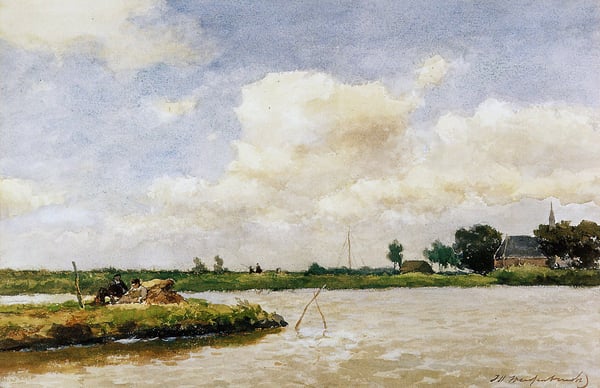
Polder at Noorden
Analisi esperta di Polder at Noorden di Johan Hendrik Weissenbruch
Stile: Realism · Genere: landscape
Expert Analysis: "Polder at Noorden" by Johan Hendrik Weissenbruch
Johan Hendrik Weissenbruch’s Polder at Noorden stands as a quintessential example of Dutch Realism and the Hague School’s devotion to capturing the understated majesty of the Netherlands’ flat, water-dominated landscape. Painted in a style that prioritizes direct observation over romantic idealization, the work elevates a seemingly mundane drainage plain into a study of atmospheric light, space, and quiet grandeur.
Significance within Realism and the Hague School:
Weissenbruch, sometimes called the "Rembrandt of the polder," was a master of the Dutch lowland scene. Unlike the dramatic mountainscapes of earlier Romanticism, Polder at Noorden embodies the Realist commitment to truth—here, the truth of a vast, horizontal horizon, a high sky, and the subtle interplay of water, reeds, and cloud shadows. The painting’s significance lies in its ability to find monumental beauty in the everyday: a canal, a windmill in the distance, the soft reflection of clouds in still water. This focus on local topography and changing weather was central to the Hague School’s break from historical or exotic subject matter.
Artistic Techniques and Atmosphere:
Weissenbruch’s brushwork is both precise and fluid. He uses a muted palette of grays, greens, and earth tones, with touches of silver and ochre, to render the damp, luminous air of the polder. The composition is deliberately simple—a low dyke cuts diagonally across the canvas, leading the eye into the deep space while a towering sky occupies two-thirds of the picture plane. This dominance of sky, typical of Dutch Realism, becomes the true subject: layered clouds drift beneath a pale sun, creating a sense of constant, gentle motion. The water mirrors these tonal shifts, while sparse vegetation (rushes, grass) anchors the scene in tactile reality.
What makes it significant:
Polder at Noorden exemplifies the Realist credo that art can be found in one’s own backyard. Weissenbruch’s work helped define a national identity rooted in the struggle against water and the beauty of reclaimed land. Compared to his contemporaries like Jozef Israëls or Anton Mauve, Weissenbruch is particularly celebrated for his ability to make the stillness of the polder feel alive. This painting, with its subtle gradations of light and its unsentimental yet deeply reverent gaze, demonstrates why the Hague School remains a cornerstone of 19th-century realism: it transforms the flat, wet landscape into a profound meditation on space, time, and the Dutch relationship with nature.
Visivamente simili
20 opere con composizione e palette affini
The Valley of the Touques. Cows in the Meadow.
Eugene Boudin
River near Dunkirk
Eugene Boudin
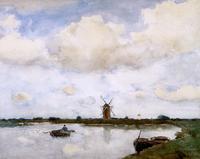
Mill at the lake
Johan Hendrik Weissenbruch
Untitled
Eugene Boudin
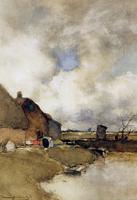
Farm near Noorden
Johan Hendrik Weissenbruch
Small Canal at Quilleboeuf
Eugene Boudin
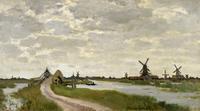
Windmills at Haaldersbroek, Zaandam
Claude Monet
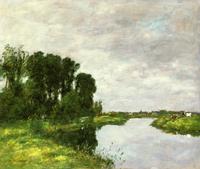
The Toques at Saint-Arnoult
Eugene Boudin
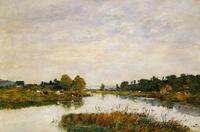
The Still River at Deauville
Eugene Boudin
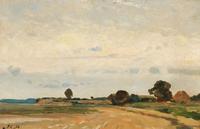
Stour River
Frederick George Cotman
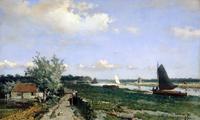
Canal at Rijswijk
Johan Hendrik Weissenbruch
Farm Along The Canal
Cornelis Vreedenburgh
Rowing on the river
Johan Hendrik Weissenbruch
Fisherman in polder landscape
Johan Hendrik Weissenbruch
Scene along a Dutch River
John Henry Twachtman
The Toques at Saint-Arnoult
Eugene Boudin
Barcos del Sena
Francisco Oller
Man in a boat in a canal
Johan Hendrik Weissenbruch
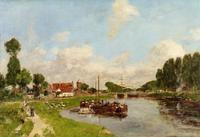
Barges on the canal at Saint-Valery-sur-Somme
Eugene Boudin
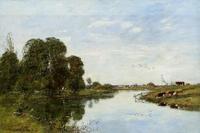
The Toques at Saint-Arnoult
Eugene Boudin