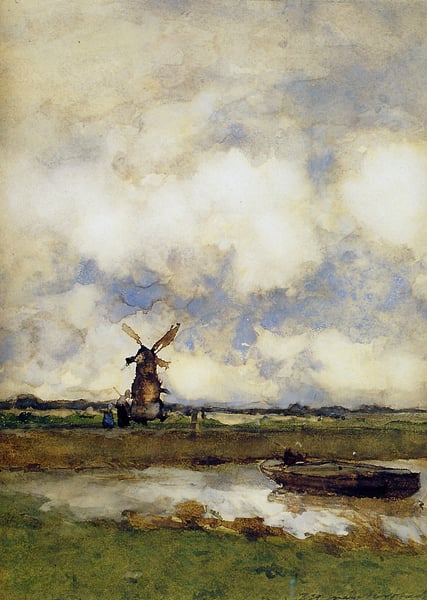
Man in a boat in a canal
Expert analysis of Johan Hendrik Weissenbruch’s Man in a boat in a canal
Style: Realism · Genre: landscape
Expert Analysis: "Man in a boat in a canal" by Johan Hendrik Weissenbruch
Johan Hendrik Weissenbruch (1824–1903) was a leading member of the Hague School, a Dutch Realist movement that flourished in the late 19th century. His work Man in a boat in a canal exemplifies the School’s core commitment to depicting the everyday Dutch landscape with unadorned truthfulness, yet it is far from a simple documentary record. What makes this painting significant within its style and period is its subtle mastery of atmosphere, tonal harmony, and the quiet drama of ordinary life.
1. Mastery of Atmospheric Realism
Weissenbruch was renowned for his ability to capture the distinctive, often damp light of the Netherlands. In this painting, the canal water is not a flat blue but a layered, reflective surface that mirrors the pale, cloud-streaked sky. The soft, silvery grey-green palette—typical of the Hague School’s “grey period”—creates a feeling of stillness and humidity. The single man in the boat becomes a small, almost incidental figure within a vast, open expanse of water and sky, emphasizing the human scale against nature. This atmospheric effect is not mere decoration; it is the central subject, rooted in the Realist aim to portray sensory truth.
2. Compositional Restraint and Depth
Unlike the dramatic compositions of Romanticism, Weissenbruch’s Realism is one of compression and silence. The canal leads the eye in a gentle recession, with the boat positioned as a quiet anchor in the middle distance. There is no overt narrative or sentimentality—just a man, a boat, and a stretch of water. This restraint is a hallmark of the Hague School’s response to the stricter, more detailed Realism of earlier French painters like Courbet; they sought not to shock but to convey the unspectacular, meditative beauty of their homeland. The painting’s significance lies in how it transforms a mundane scene—a man slowly moving along a canal—into a meditation on light, reflection, and transient time.
3. Connection to Broader 19th-Century Realist Trends
Within the international Realist movement, Weissenbruch’s work stands out for its specifically Dutch character. Like his contemporaries Anton Mauve and Hendrik Willem Mesdag, he rejected the idealized landscapes of the past in favor of direct observation. Yet Man in a boat in a canal goes further: the loose, almost impressionistic handling of the water’s ripples and the sky’s clouds—visible in the broad, confident brushstrokes—anticipates the tonalism that would later influence even the early works of Vincent van Gogh. This painting is not just a record of a location; it is a study in how light and water interact, a subject that would become a touchstone for modernist landscape painters.
Significance Within the Hague School
While Weissenbruch is often overshadowed by the more famous members of the School, works like this one underscore his role as a master of the canal and polder landscape. He captured a quintessentially Dutch scene—the everyday life of the waterways—with a quiet, profound honesty. The man in the boat is anonymous, yet his presence humanizes the vastness, tying the landscape to labor and livelihood. In this, the painting achieves what the best Hague School Realism does: it finds the monumental in the modest, and it invites the viewer to pause and look—not at a story, but at a moment of light and water.
Visually similar
20 works with related composition and palette
Mill at the lake
Johan Hendrik Weissenbruch
Dutch polder landscape
Johan Hendrik Weissenbruch
Scene along a Dutch River
John Henry Twachtman
The Inlet
John Henry Twachtman
Farm near Noorden
Johan Hendrik Weissenbruch
Polder at Noorden
Johan Hendrik Weissenbruch
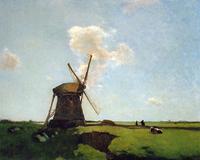
Polder landscape
Johan Hendrik Weissenbruch
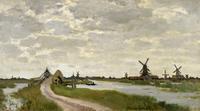
Windmills at Haaldersbroek, Zaandam
Claude Monet
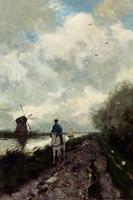
On The Tow Path Along The River Amstel
Johan Hendrik Weissenbruch
View of Neuss
Andreas Achenbach
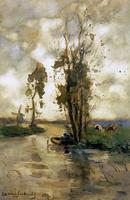
Fisherman in polder landscape
Johan Hendrik Weissenbruch
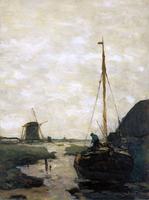
Ship in polder canal
Johan Hendrik Weissenbruch
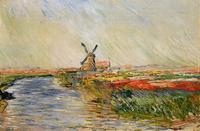
Tulip Field in Holland
Claude Monet
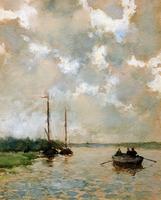
Rowing on the river
Johan Hendrik Weissenbruch
Spring Ploughing
John Constable
Scene with a Windmill
James Webb
Stormy Weather, Pas de Calais
Camille Corot
Canal at Rijswijk
Johan Hendrik Weissenbruch
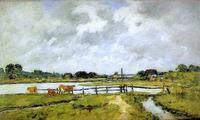
The Valley of the Touques. Cows in the Meadow.
Eugene Boudin
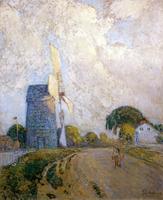
Windmill at Sundown, East Hampton
Childe Hassam