
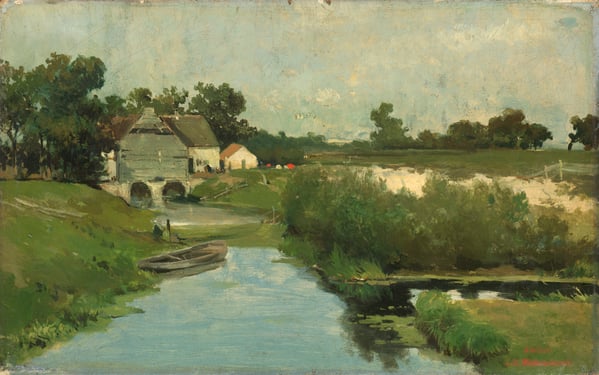
Analisi esperta di Summer Day di Johan Hendrik Weissenbruch
Stile: Realism · Genere: landscape
Expert Analysis: "Summer Day" by Johan Hendrik Weissenbruch
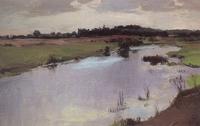
Johan Hendrik Weissenbruch was a leading figure of the Hague School, a Dutch Realist movement that emerged in the mid‑19th century. In Summer Day, he demonstrates the core tenets of Realism—truthful, unembellished observation of nature—while elevating a seemingly ordinary landscape into a study of light, atmosphere, and the Dutch countryside.
Significance within Realism:
Unlike the grandiose or idealized landscapes of Romanticism, Weissenbruch’s work focuses on the quiet drama of the everyday. The painting is notable for its masterful handling of sky and weather: a vast, cloud-filled expanse dominates the composition, with subtle gradations of gray and white capturing the shifting light of a breezy summer day. This attention to atmospheric conditions—a hallmark of Realist landscape painting—reflects the influence of the Barbizon school and the burgeoning preoccupation with plein air observation.
Technical and Aesthetic Contributions:
Weissenbruch’s loose, confident brushwork in the foreground (likely depicting a meadow or waterway) and his restrained palette of soft greens, blues, and earth tones convey a sense of immediate, unposed nature. The horizontal sweep of the land and the low horizon line are characteristic of the Dutch polder landscape, anchoring the scene in a specific regional identity. Yet, the artist’s emphasis on the transient effects of light and shadow—particularly the contrast between the sunlit patches and the layered clouds—prefigures the concerns of Impressionism, making Summer Day a transitional work that bridges Realist sincerity with proto‑Impressionist visual sensation.
Legacy:
Weissenbruch was celebrated in his time for his “gray period” paintings, in which muted, silvery tones evoke the humid, ever‑changing Dutch sky. Summer Day exemplifies this achievement: it is not a portrait of a dramatic vista, but a quiet, resonant meditation on the ordinary beauty of a summer afternoon. Its significance lies in how it transforms a simple, real‑world moment into a timeless expression of atmospheric nuance—a key contribution to the evolution of modern landscape painting.
Museum / Gallery
Visivamente simili
20 opere con composizione e palette affini
Landscape Lesquielles St Germain
Henri Matisse
House by yhe Water's Edge
Frits Thaulow
River near Dunkirk
Eugene Boudin
Connecticut Landscape
John Henry Twachtman
Farm Scene
Willard Metcalf
A Tranquil River Landscape, with Ducks in the foreground, and Cattle and Drover by a Stone Bridge
Edward Arthur Walton
River near hospital
Eugene Boudin
Landscape With River and Trees
Theodor Aman
The Meadows, Gloucester, New Jersey
Thomas Eakins
Bauernhof am Fluss
Hugo Darnaut
Autumn Landscape
Johan Hendrik Weissenbruch
Arleux du Nord, the Drocourt Mill, on the Sensee
Camille Corot
Autumn Landscape (Farm and pond)
Paul Gauguin
The Toques at Saint-Arnoult
Eugene Boudin
The River Vorya at Abramtsevo
Konstantin Korovin
An Afternoon's Fishing
Edward Wilkins Waite
Peat digging
Paula Modersohn-Becker
The Toques at Saint-Arnoult
Eugene Boudin
The Toques at Saint-Arnoult
Eugene Boudin
River
Arkady Rylov