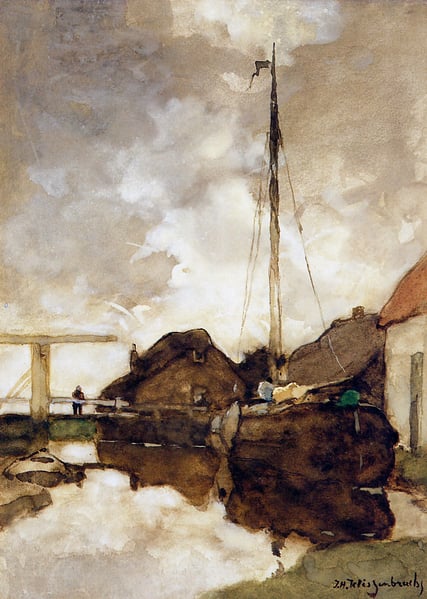
View on canal
Analisi esperta di View on canal di Johan Hendrik Weissenbruch
Stile: Realism · Genere: landscape
Expert Analysis: "View on canal" by Johan Hendrik Weissenbruch
Johan Hendrik Weissenbruch (1824–1903) was a leading figure in the Hague School, a movement that revitalized Dutch landscape painting in the 19th century by embracing Realism—a commitment to depicting nature with direct observation, honesty, and atmospheric truth. This work, View on canal, exemplifies the artist’s mastery within the landscape genre and his contribution to the Realist tradition.
Significance within the Style:
- Atmospheric Realism: Weissenbruch was celebrated for his ability to capture the shifting light and moist air of the Dutch lowlands. In View on canal, this is achieved through a restrained palette of grays, muted blues, and soft earth tones, where the sky often dominates the composition. The canal’s still water mirrors the overcast heavens, creating a unified, almost monochromatic harmony that is both truthful to the locale and deeply atmospheric.
- Brushwork and Texture: Unlike the polished finish of earlier landscape conventions, Weissenbruch used a loose, brisk brushstroke—especially in the sky and water—to convey the transient effects of weather. This “rough” handling, typical of the Hague School’s Realist approach, emphasizes the materiality of paint while preserving the illusion of natural light and movement.
- Structure and Depth: The composition is deceptively simple: a low horizon line, a broad sky, and the canal receding into the distance. This horizontal format, reminiscent of 17th-century Dutch landscape masters, anchors the scene in a long national tradition. Yet Weissenbruch updates it with a modern sensitivity to fleeting moments—a breeze rippling the surface, a patch of sunlight breaking through clouds.
Significance as a Landscape:
- View on canal is not a mere topographic record. It is a study of the quintessential Dutch terrain: man-made waterways, flat polders, and expansive skies. Weissenbruch elevates the ordinary—a canal, boats, a distant village—into a subject of profound contemplation. His Realist lens refuses romantic exaggeration; instead, he finds poetry in the quiet, gray day, the reflections, and the subtle gradations of tone.
- The work stands as a hallmark of the Hague School’s contribution to 19th-century Realism: a refusal to idealize nature, yet a deep reverence for its fleeting beauty. Through this canal view, Weissenbruch demonstrates that the most unassuming scenery can hold the greatest power when observed with sincerity and skill.
Visivamente simili
20 opere con composizione e palette affini
Ship in polder canal
Johan Hendrik Weissenbruch
Ships on canal
Johan Hendrik Weissenbruch
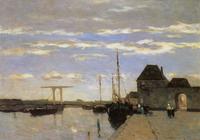
Memory of Haarlem
Johan Hendrik Weissenbruch
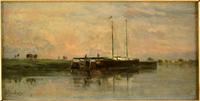
The barges in Bezons
Charles-Francois Daubigny
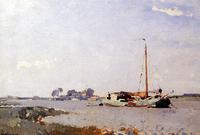
Ships On A Puddle
Cornelis Vreedenburgh
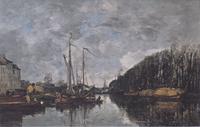
Channel at Allèe Verte in Brussels
Eugene Boudin
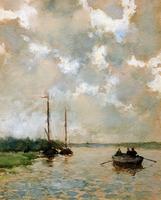
Rowing on the river
Johan Hendrik Weissenbruch
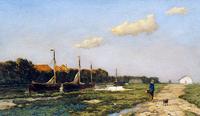
Along the canal
Johan Hendrik Weissenbruch
View On The IJ In Amsterdam
Cornelis Vreedenburgh
Boats at Zaandam
Claude Monet
Farm near Noorden
Johan Hendrik Weissenbruch
At the Boat Landing
William Merritt Chase
Barges on the canal at Saint-Valery-sur-Somme
Eugene Boudin
Zaandam, The Dike, Evening
Claude Monet
Blue Barge
Paul Gauguin
Gloucester Boats
John Henry Twachtman
Pleasure Boats, Argenteuil, c.1872-3 (oil on canvas)
Claude Monet
Fishing Port
Charles-Francois Daubigny
Rosbras, Brittany
Berthe Morisot
Frozen In Ship
Cornelis Vreedenburgh