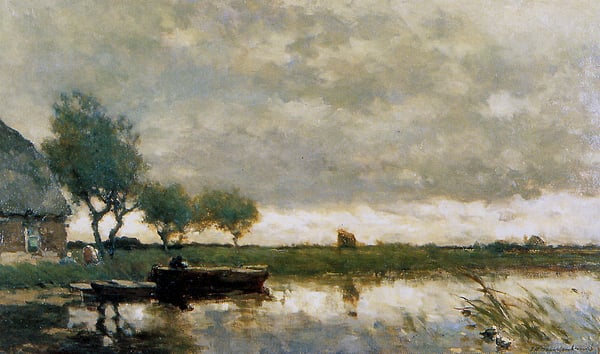
Windy day
Expertenanalyse zu Johan Hendrik Weissenbruchs Windy day
Stil: Realism · Genre: landscape
Expert Art Historical Analysis: "Windy Day" (c. 1870s–1880s) by Johan Hendrik Weissenbruch
Johan Hendrik Weissenbruch (1824–1903) was a leading figure of the Hague School, a movement that championed a naturalistic and atmospheric approach to landscape painting inspired by the 17th-century Dutch Golden Age. Windy Day exemplifies his distinctive realist vision, rooted in the observation of the Dutch polder countryside and its ever-changing skies.
Formal and Technical Significance
Weissenbruch’s handling of paint is a masterclass in verisimilitude. The composition is dominated by a low horizon, a hallmark of Dutch landscape tradition, allowing the expansive, turbulent sky to occupy nearly three-quarters of the canvas. The artist builds the wind’s motion through broad, diagonal brushstrokes and a muted palette of grays, silvers, and cool whites—capturing the subtle shift of light as clouds race overhead. The foreground, likely showing a sodden meadow or a narrow waterway, is rendered with earthy browns and greens, its broken brushwork suggesting the restless surface of windblown grass or rippling water.
Thematic Significance within Realism
This work is significant for its unromanticized depiction of everyday Dutch climate. Unlike the idealized pastoral scenes of earlier Romanticism, Weissenbruch’s realism focuses on the raw, impersonal force of nature. The absence of human figures or dramatic events emphasizes the elemental power of wind and light, making the landscape itself the sole protagonist. This aligns with the Hague School’s mission to record the transient, specific moods of the Netherlands—often called “gray” or “tonal” painting, where atmosphere takes precedence over anecdote.
Legacy and Influence
Windy Day is exemplary of Weissenbruch’s ability to render the “soul of the landscape” through loose, energetic brushwork that anticipates the looser handling of later Impressionism, yet remains grounded in direct observation. His mastery of aerial perspective and weather effects influenced not only his Dutch contemporaries (such as Jozef Israëls and Anton Mauve) but also international Realist painters who sought to capture the unadorned truth of a place. In its frank portrayal of a blustery day, the work stands as a testament to the core realist belief that everyday nature, in its most ordinary yet powerful moments, is worthy of profound artistic attention.
Visuell ähnlich
20 Werke mit ähnlicher Komposition und Farbpalette
Autumn Landscape
Johan Hendrik Weissenbruch
Farm on polder canal
Johan Hendrik Weissenbruch
Farmhouses On The Waterfront
Johan Hendrik Weissenbruch
Landscape with a farm pond
Johan Hendrik Weissenbruch
The washing place
Johan Hendrik Weissenbruch
Cottages near pond
Theodore Rousseau
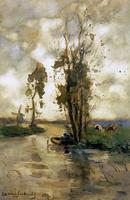
Fisherman in polder landscape
Johan Hendrik Weissenbruch
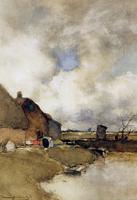
Farm near Noorden
Johan Hendrik Weissenbruch
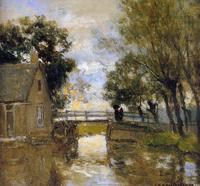
Summer evening
Johan Hendrik Weissenbruch
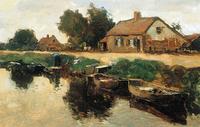
Farm Along The Canal
Cornelis Vreedenburgh
River near Dunkirk
Eugene Boudin
Farmhouse on a canal
Johan Hendrik Weissenbruch
Landscape With Houses and Stream
John Henry Twachtman
Landscape at Sunset
Vincent van Gogh
Horseman on a tow path
Johan Hendrik Weissenbruch
Along the Canal
Johan Hendrik Weissenbruch
The Still River at Deauville
Eugene Boudin
Fishermen in a Boat
Camille Corot
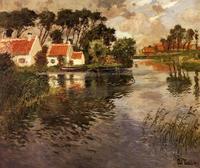
Cottages by a River
Frits Thaulow
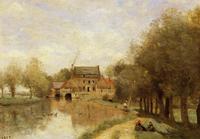
Arleux du Nord, the Drocourt Mill, on the Sensee
Camille Corot