Summer evening
Expert analysis of Johan Hendrik Weissenbruch’s Summer evening
Style: Realism · Genre: landscape
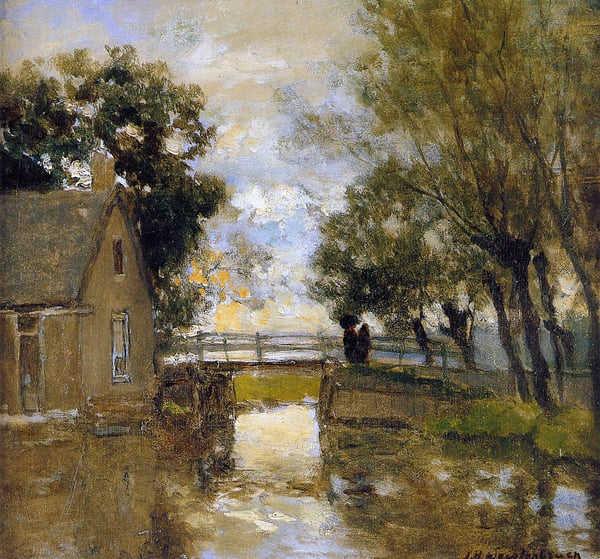
As an expert art historian, I will analyze "Summer evening" by Johan Hendrik Weissenbruch based on the provided facts. This work is a landscape in the Realist style, and its significance lies in how it exemplifies the core tenets of the Hague School—a distinctly Dutch strain of Realism that emerged in the late 19th century.
Artwork: Summer evening
Artist: Johan Hendrik Weissenbruch (1840–1903)
Style: Realism (specifically, the Hague School variant)
Genre: Landscape
What makes this artwork significant within its style and period:
Weissenbruch, often called the "painter of the Dutch sky," was a leading figure of the Hague School, a movement that rejected the idealized, dramatic landscapes of Romanticism in favor of a truthful, unembellished depiction of the Dutch countryside. Summer evening stands as a quintessential example of this approach.
First, the painting’s significance lies in its devotion to atmospheric truth. Unlike earlier landscape traditions that might impose a narrative or heroic mood, Weissenbruch focuses on the quiet, transient poetry of a specific moment: dusk in summer. The work captures the soft, fading light—a hallmark of Hague School realism—where the sky dominates the composition as a subtle play of grays, blues, and warm afterglow. This emphasis on the fleeting quality of light and air was directly influenced by the Barbizon School (notably Corot) and the artists’ practice of working en plein air to observe nature faithfully.
Second, the painting demonstrates Weissenbruch’s mastery of tonal harmony and atmospheric perspective. Unlike the high-contrast drama of the Romantic landscape, Summer evening likely employs a restrained palette of muted greens, browns, and silvers, with the horizon softened by haze. This reduced, tonal palette was a defining characteristic of the Hague School, aimed at conveying the damp, luminous atmosphere of the Netherlands. The resulting sense of calm and spatial depth is not decorative but analytical—a deliberate study of how light and moisture shape our perception of a landscape.
Finally, the work is significant for its vernacular subject matter. Rather than depicting dramatic mountains or storms, Weissenbruch chooses a humble, familiar scene: a field or meadow at dusk. This choice reflects the Realist credo that everyday, modest landscapes are worthy of serious artistic treatment. The absence of human figures or narrative action forces the viewer to engage solely with the quality of light, the texture of the sky, and the expansive sense of space—making Summer evening a pure, meditative landscape that elevates the ordinary to the sublime through meticulous observation.
In summary, Summer evening is significant because it embodies the Hague School’s core achievement: using the principles of Realism to transform the Dutch landscape into a vehicle for atmospheric truth, tonal subtlety, and quiet contemplation. It is a work where fidelity to nature becomes a form of poetry.
Visually similar
20 works with related composition and palette
Farm on polder canal
Johan Hendrik Weissenbruch
Fisherman in polder landscape
Johan Hendrik Weissenbruch
Windy day
Johan Hendrik Weissenbruch
Landscape with a farm pond
Johan Hendrik Weissenbruch
Arleux du Nord, the Drocourt Mill, on the Sensee
Camille Corot
Farmhouses On The Waterfront
Johan Hendrik Weissenbruch
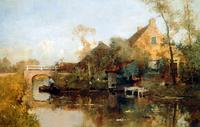
Farm next to canal
Cornelis Vreedenburgh
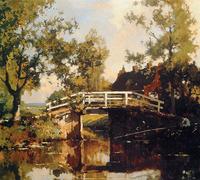
Bridge Near Estate Linschoten
Cornelis Vreedenburgh
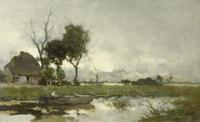
Autumn Landscape
Johan Hendrik Weissenbruch
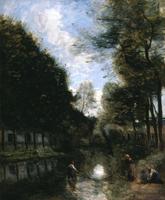
Gisors, River Bordered by Trees
Camille Corot
Farm Along The Canal
Cornelis Vreedenburgh
The washing place
Johan Hendrik Weissenbruch
Cottages by a River
Frits Thaulow
Landscape at Sunset
Vincent van Gogh
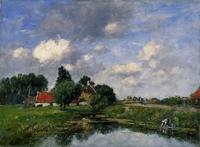
River near Dunkirk
Eugene Boudin
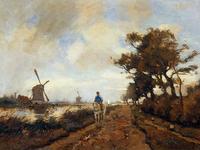
Horseman on a tow path
Johan Hendrik Weissenbruch
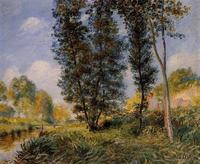
Banks of the Orvanne
Alfred Sisley
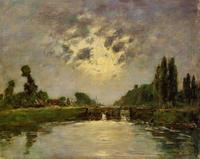
Saint-Valery-sur-Somme, the Bridge on the Lock
Eugene Boudin
Landscape With Houses and Stream
John Henry Twachtman
Sluice Of Woerdense Verlaat
Cornelis Vreedenburgh