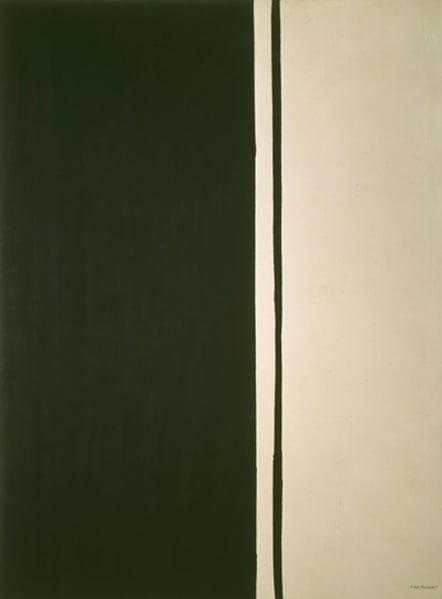
Expert analysis of Barnett Newman’s Black Fire I
Style: Color Field Painting · Genre: abstract
"Black Fire I" by Barnett Newman stands as a seminal work within the Color Field Painting movement, where Newman pushed abstraction beyond mere form toward a deeply spiritual and existential experience. Executed in the artist’s signature idiom, the painting is defined by a vast, monolithic field of intense black—interrupted only by a vertical stripe (or “zip”) of contrasting hue. This zip does not simply divide the canvas; it activates the entire surface, creating a dynamic tension between the engulfing darkness and the piercing line of light.
What makes this work significant is its radical reduction of pictorial elements to confront the viewer with the sublime. Newman rejected composition in favor of a single, unified field that evokes both primal chaos and transcendent order. “Black Fire I” exemplifies how Color Field artists used sheer scale, flat color, and minimal gesture to elicit a visceral, almost ritualistic response. Here, the black is not an absence but a presence—weighted, dense, and charged—while the zip functions as a rupture, a spark of creation. This piece encapsulates Newman’s lifelong quest to express the ineffable, positioning abstraction not as decoration but as a gateway to the monumental and the numinous.
Genre
Style
Visually similar
20 works with related composition and palette
Inval
Raoul De Keyser
Adam and Eve (#2)
Frederick Hammersley
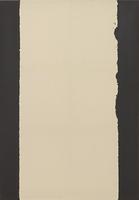
Burnt Umber & Ultramarine Blue
Yun Hyong–keun
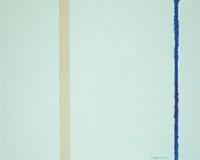
White Fire I
Barnett Newman
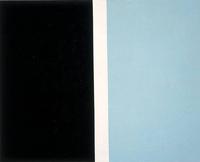
Number 14
John McLaughlin
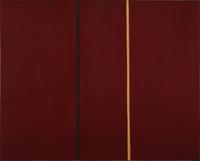
Covenant
Barnett Newman
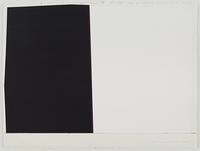
Summer 88, No. 6
Anne Truitt

Number 17
John McLaughlin
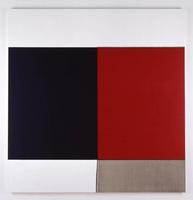
Exposed Painting Cadmium Red light
Callum Innes
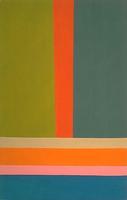
Big A
Jack Bush
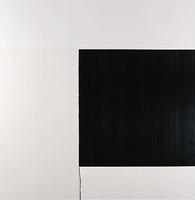
Exposed Painting Black Oxide
Callum Innes
Study for Stander
Brice Marden
28.5.66
John Hoyland
Untitled No. 5
Michael Heizer
Umber Blue
Yun Hyong–keun

Ligne rouge II n°19
Genevieve Asse
Untitled
Gene Davis
White, Black, Yellow, and Red
Ilya Bolotowsky
Komposition Blau-Rot auf Weiss
Blinky Palermo
Untitled (Litograph)
John Hoyland