
Deskundige analyse van Onement I van Barnett Newman
Stijl: Color Field Painting · Genre: abstract
Expert Analysis of Onement I by Barnett Newman
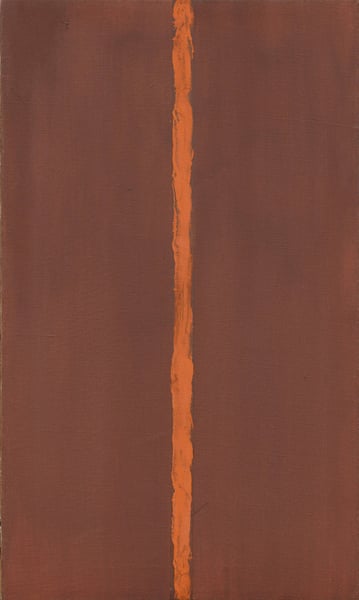
Barnett Newman’s Onement I (1948) stands as a pivotal breakthrough in postwar American abstraction and a defining work of the Color Field movement. Painted at a critical juncture in the artist’s career, this small but monumental canvas marks the first appearance of Newman’s signature “zip”—a vertical band of color that cuts through a unified field, here a deep, earthy dark red against a slightly lighter, textured ground.
Significance within the Color Field Style
Unlike the gestural energy of Abstract Expressionism, Newman sought a sublime, transcendent experience through vast expanses of color and stark, minimal structure. Onement I exemplifies this shift: the entire composition is dominated by a single, almost monochrome color field, broken only by the irregular vertical stripe applied with masking tape. This “zip” is not a line in the traditional sense; it is a zone of tension that activates the surrounding space, creating a sense of both separation and union. Newman described it as a “point of contact” between the viewer and the infinite—a doorway rather than a boundary.
What Makes It Historically Significant
-
The Birth of the Zip – This is Newman’s first use of the vertical stripe, which would become his lifelong signature device. Before Onement I, his work was still tied to surrealist biomorphism; here, he abandoned all figurative remnants in favor of pure, elemental structure.
-
A New Kind of Space – Newman intended the viewer to stand very close to the canvas, so that the color field engulfs peripheral vision. The zip then creates a dynamic, almost physical experience of space—what he called a “sensation of place.” This redefined abstraction as an environment rather than a picture.
-
Spiritual and Mythic Resonance – Newman was deeply influenced by Jewish mysticism and existential philosophy. The vertical line has been interpreted as a primal act of creation—like the tzimtzum (divine contraction) in Kabbalah—or as a figural stand-in for humanity standing upright. The title Onement (deliberately archaic for “atonement” or “making one”) signals a desire to heal the divide between self and cosmos.
-
Influence on Later Movements – Onement I prefigures Minimalism’s reduction to essential forms and anticipates the “field” paintings of Helen Frankenthaler and Morris Louis. Yet Newman insisted his work was not about formal purity but about presence and awe.
In summary, Onement I is significant because it distilled abstraction to its most irreducible—a single color, a single vertical mark—yet conjured an immense, contemplative space. It remains a touchstone for how abstract art can evoke the sublime through radical simplicity.
Museum / Gallery
Visueel vergelijkbaar
20 werken met verwante compositie en kleurenpalet
Galaxy
Barnett Newman
Covenant
Barnett Newman
Umber Blue
Yun Hyong–keun
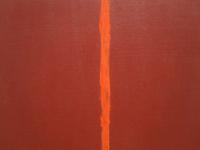
Onement III
Barnett Newman
Kasseler Serie
Gunther Forg
Onement V
Barnett Newman
Paris Green
Doug Ohlson
Key of Acco 2
Jules Olitski
Concord
Barnett Newman
Who’s Afraid of Red, Yellow and Blue II
Barnett Newman
Umber Black
Yun Hyong–keun
Black Fire I
Barnett Newman
28.5.66
John Hoyland
Ocean Park #45
Richard Diebenkorn
Canto II
Barnett Newman
Inval
Raoul De Keyser
Untitled Mural for End Wall
Mark Rothko
Untitled Green Monochrome
Yves Klein
Monocromo blu
Mario Schifano

Umber Blue
Yun Hyong–keun