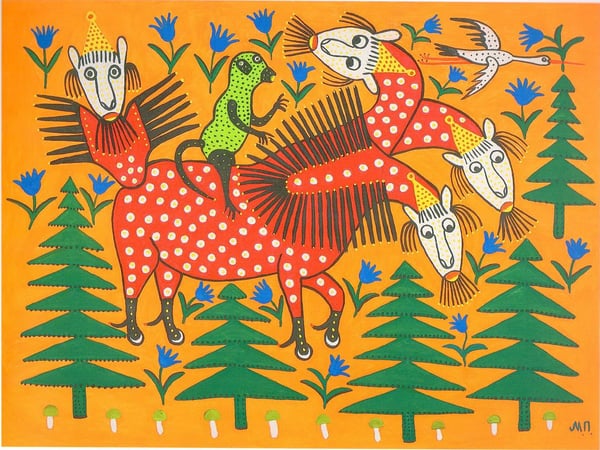
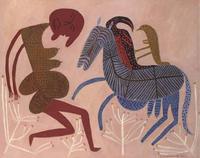
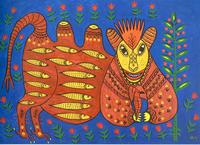
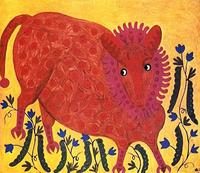
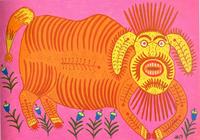
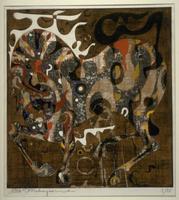
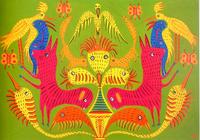
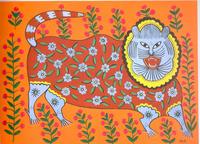
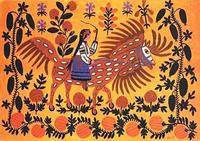
Maria Primachenko’s “Monkey Riding a Four-Headed Beast” exemplifies the defining traits of Naïve Art (Primitivism) while making a distinct contribution to the genre of mythological painting. The work’s significance stems from its fusion of folkloric imagination with the anti-academic spontaneity characteristic of naïve aesthetics. By depicting a monkey astride a fantastical, multi-headed creature, Primachenko invents a personal mythology that bypasses classical narrative conventions, instead drawing on Ukrainian folk traditions and a direct, untutored visual language. The four-headed beast suggests a surreal, chimeric being—neither wholly terrifying nor wholly benign—while the monkey rider introduces a note of playful absurdity. This combination underscores the naïve artist’s freedom from naturalistic proportion or anatomical accuracy, prioritizing symbolic resonance over literal representation. In the broader context of Primitivism, Primachenko’s work stands out for its cultural grounding: her mythological subjects are not nostalgic or colonial fantasies but vibrant expressions of a living folk heritage, recast through a modernist lens. The painting thus bridges rural folk art and early 20th-century avant-garde tendencies, elevating naïve expression to a sophisticated, self-contained mythological system.