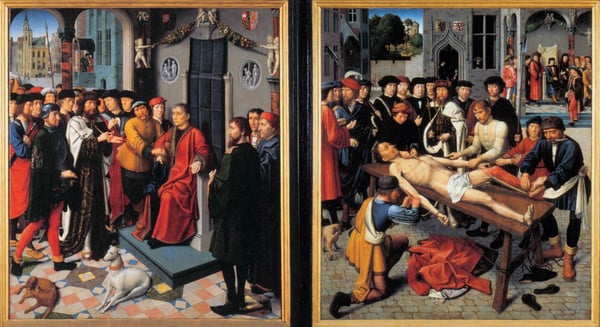
The Judgement of Cambyses (2 panels)
Dettagli
Analisi esperta di The Judgement of Cambyses (2 panels) di Gerard David
Stile: Northern Renaissance · Genere: religious painting
Expert Analysis: The Judgement of Cambyses (Two Panels) by Gerard David
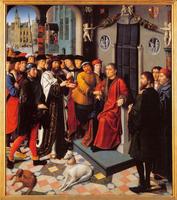
Gerard David’s The Judgement of Cambyses (c. 1498) is a masterwork of the Northern Renaissance that transforms a grim historical legend into a potent civic and religious allegory. Painted for the Aldermen’s Chamber of the Bruges Town Hall, the two panels depict the ancient Persian king Cambyses ordering the flaying of the corrupt judge Sisamnes, followed by the judge’s son being appointed as his successor—forced to sit on a bench upholstered with his father’s skin.
Significance within the Northern Renaissance and Religious Painting:
-
Moralized Justice as a Sacred Duty: While nominally a religious painting in its moral framework, the work secularizes biblical allegory to address contemporary civic law. The flaying is not a biblical scene but a classical one, yet David treats it with the same solemn, instructive iconography as a martyrdom. This fusion of classical history and Christian ethics exemplifies the Northern Renaissance’s redefinition of “religious” art to include moral exempla for governance.
-
Gruesome Realism and Symbolic Detail: True to Northern Renaissance ideals, David renders the flaying with surgical precision—the judge’s skin is peeled in meticulous folds, blood pools with naturalistic color, and the expressions range from stoic resignation to clinical detachment. Yet every detail carries symbolic weight: the judge’s ermine-trimmed robe (vanity of office) lies discarded, while the new judge’s bench, covered in human hide, literalizes the warning “justice must be felt.” The gold-ground background typical of earlier religious panels is replaced by a sober, architectural interior, grounding the scene in a recognizable contemporary courtroom.
-
Civic Function as Altarpiece of Law: Unlike a typical altarpiece for a church, this diptych hung in a secular hall where magistrates deliberated. Its significance lies in its functional purpose: the painting was a perpetual visual oath, reminding officials of the terrifying consequences of corruption. This merges the devotional intensity of a religious panel with the didactic urgency of political propaganda—a hallmark of Burgundian Netherlandish art.
-
Technical Virtuosity: David demonstrates the Northern Renaissance obsession with texture and light: the glint of armor, the translucency of skin, the polished wood of the bench, and the subtle modeling of drapery all evidence his training in the Bruges tradition (descended from Jan van Eyck). The dual-panel format also creates a narrative “before” and “after,” encouraging sequential viewing akin to reading scripture.
Conclusion: The Judgement of Cambyses is significant not only for its shocking imagery but for its radical redefinition of religious painting as a tool for social accountability. It stands as a pinnacle of Northern Renaissance moral realism, where beauty and horror are harnessed to serve justice—a theme that resonates far beyond its original civic context.
Museum / Gallery
Visivamente simili
20 opere con composizione e palette affini
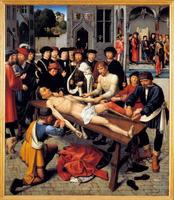
The Flaying of the Corrupt Judge Sisamnes
Gerard David
Triptych The Pearl of Brabant. Left wing: St. John the Baptist, middle panel: Adoration of the Magi, right wing: St. Christopher
Dirk Bouts
Saint Columba Altarpiece
Rogier van der Weyden
Adoration of the Magi: Whole Triptych
Hans Memling
Winged altar in St. Peter in Leuven
Dirk Bouts
St. John Altarpiece left wing
Hans Memling
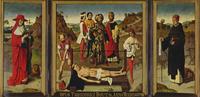
Martyrdom of Saint Erasmus
Dirk Bouts
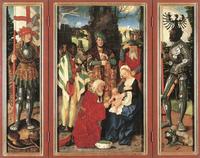
Adoration Of The Magi
Hans Baldung
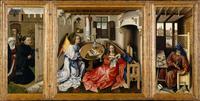
The Mérode Altarpiece
Robert Campin
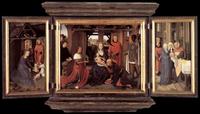
Triptych of Jan Floreins
Hans Memling
St. Hippolytus Triptych
Dirk Bouts
St.Hippolyte Triptych
Hugo van der Goes
The Judgement of Cambyses
Gerard David
Wings of a Triptych
Hans Memling
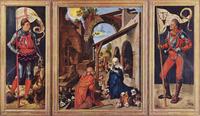
Paumgartner Altarpiece (center panel - The Nativity, wings - St. George, St. Eustace)
Albrecht Durer
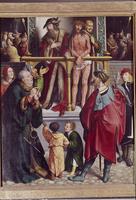
Ecce Homo
Jan Joest
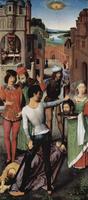
Triptych of the Mystical Marriage of St. Catherine of Alexandria, left wing: The Beheading of John the Baptist
Hans Memling
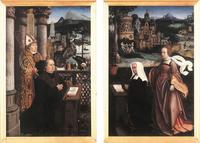
Donor with St. Nicholas and his Wife with St. Godelina
Jan Provoost
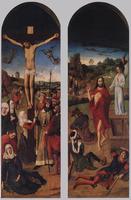
Passion Altarpiece (side wings)
Dirk Bouts
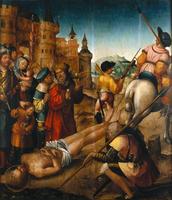
Martírio de Santo Hipólito
Cristovao de Figueiredo