
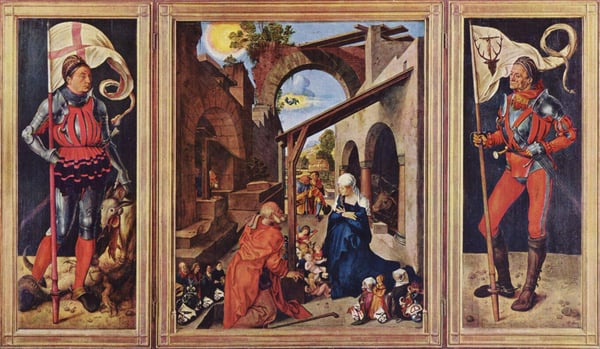
Paumgartner Altarpiece (center panel - The Nativity, wings - St. George, St. Eustace)
Details
Expert analysis of Albrecht Durer’s Paumgartner Altarpiece (center panel - The Nativity, wings - St. George, St. Eustace)
Style: Northern Renaissance · Genre: religious painting
The Paumgartner Altarpiece by Albrecht Dürer is a landmark work of the Northern Renaissance, created around 1503 for the Church of St. Catherine in Nuremberg. Its significance lies in how Dürer masterfully synthesizes the meticulous observation and symbolic complexity of Northern European art with the spatial coherence and classical ideals of the Italian Renaissance—a synthesis that defines his genius and the period’s evolution.
Center Panel – The Nativity:
Dürer transforms the traditional Nativity into a deeply human and intimate scene. The crumbling stable architecture (a ruin symbolizing the old covenant) frames the Holy Family with precise linear perspective, a Renaissance innovation Dürer absorbed during his travels to Italy. The figures are rendered with Northern attention to texture—straw, wood, fabric—and the soft, luminous chiaroscuro models their forms, giving them sculptural weight. The infant Christ radiates divine light, a motif that merges devotional symbolism with naturalistic dawn light. The inclusion of the ox and ass, common in Northern art, anchors the scene in earthy realism. Dürer’s use of rich, deep colors (the Virgin’s blue, Joseph’s warm browns) demonstrates his advanced oil technique.
Wings – St. George and St. Eustace:
These panels are extraordinary for their dual function: they depict the patron saints of two brothers from the Paumgartner family, who are shown as the saints themselves—a bold integration of donor portraiture into sacred narrative. St. George stands in full armor, slaying the dragon, his pose echoing classical equestrian statues, while the landscape behind him recedes in atmospheric perspective. St. Eustace kneels before a stag bearing a crucifix, a vision rendered with incredible naturalism—every leaf and animal hair is meticulously detailed. The armor reflects light with metallic precision, a hallmark of Dürer’s printmaking background applied to painting.
Significance within the Northern Renaissance:
- Synthesis of Traditions: Dürer bridges the Gothic love of detail (every fold, jewel, and hair) with Renaissance ideals of balanced composition, anatomical accuracy, and unified perspective.
- Portrait as Devotion: By casting actual donors as saints, Dürer creates a personal, familial link between the worshiper and the holy scene, anticipating the Reformation’s emphasis on individual faith.
- Technical Mastery: The altarpiece showcases Dürer’s ability to manipulate oil paint for both smooth, glazed highlights and deep, transparent shadows—a technique he learned from Venetian artists and refined.
- Narrative Innovation: The wings are not static; St. George is caught in action, St. Eustace in revelation, and the central Nativity is a quiet, profound moment. Together, they create a triptych that leads the viewer from earthly struggle (George) through mystical encounter (Eustace) to divine incarnation.
This work stands as a testament to Dürer’s role as the first Northern artist to fully embrace the Renaissance while retaining the emotional depth and symbolic density of his Northern heritage, making the Paumgartner Altarpiece a pivotal bridge between medieval and modern religious art.
Museum / Gallery
Visually similar
20 works with related composition and palette
Adoration Of The Magi
Hans Baldung
Saint Columba Altarpiece
Rogier van der Weyden
Triptych of Jan Floreins
Hans Memling
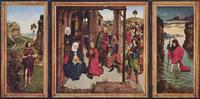
Triptych The Pearl of Brabant. Left wing: St. John the Baptist, middle panel: Adoration of the Magi, right wing: St. Christopher
Dirk Bouts
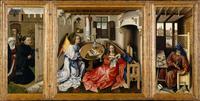
The Mérode Altarpiece
Robert Campin
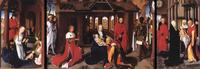
Adoration of the Magi: Whole Triptych
Hans Memling
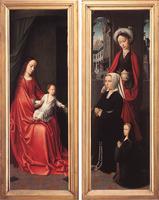
Triptych of Jan Des Trompes (rear of wings)
Gerard David
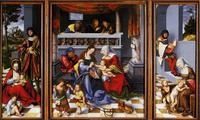
The Holy Family
Lucas Cranach the Elder
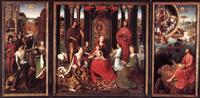
St. John Altarpiece
Hans Memling
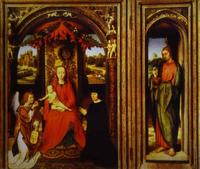
Altar of Saints John the Baptist and John the Evangelist
Hans Memling
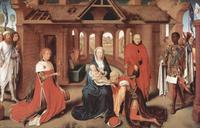
Adoration of the Magi, central panel of the Triptych of the Adoration of the Magi
Hans Memling
Triptych
Hans Memling
The middle panel of The Pearl of Brabant: Adoration of the Magi
Dirk Bouts
The Three Kings Altarpiece
Hans Baldung
Saint Sebastian
Bartolome Bermejo
The Judgement of Cambyses (2 panels)
Gerard David
Adoration of the Kings (Epiphany)
Pietro Perugino
Moses's Journey into Egypt and the Circumcision of His Son Eliezer (detail)
Pietro Perugino
Polittico di Sansepolcro (detail)
Il Sassetta (Stefano di Giovanni)
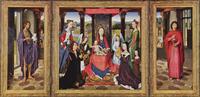
The Virgin and Child with Saints and Donors (The Donne Triptych)
Hans Memling