
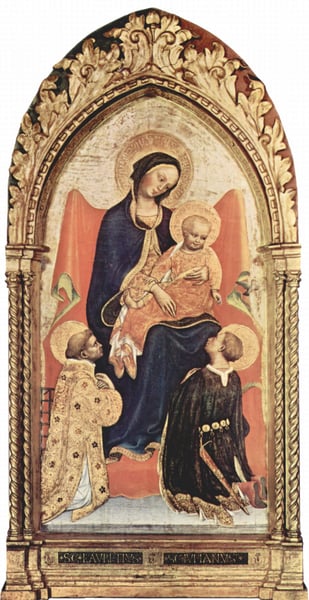
Madonna with St. Julian and St. Laurenzius
Dettagli
Analisi esperta di Madonna with St. Julian and St. Laurenzius di Gentile da Fabriano
Stile: International Gothic · Genere: religious painting
As an expert in early 15th-century Italian painting, I can tell you that Gentile da Fabriano’s Madonna with St. Julian and St. Laurenzius is a quintessential masterpiece of the International Gothic style, a period defined by its fusion of naturalistic observation with exquisite decorative refinement. Created as a religious panel, the work achieves its significance through the perfect balance of sacred dignity and courtly elegance that characterizes the finest examples of this movement.
Stylistic Significance within International Gothic:
Gentile da Fabriano was the leading exponent of International Gothic in Italy, and this painting demonstrates the style’s hallmarks: a lyrical, flowing line; rich, ornamental surfaces; and a luminous, gold-infused palette. The Madonna is presented as a heavenly queen, yet she is imbued with a tender, human grace — her figure gently swaying, her robes cascading in rhythmic folds that mirror the sinuous curves of the Gothic script. The extensive use of gold leaf and meticulous tooling (visible in halos and textile patterns) elevates the sacred subject into a shimmering, otherworldly vision, while the naturalistic details — such as the soft modeling of faces and the careful rendering of fabrics — anchor the scene in recognizable reality.
Composition and Iconography:
The grouping of the Virgin and Child with two saints, Julian and Laurenzius (Lawrence), follows a standard sacra conversazione format, but Gentile transforms it into a intimate, lateral arrangement that feels both hierarchical and approachable. Saint Julian, traditionally associated with hospitality and pilgrimage, and Saint Lawrence, the deacon-martyr, are individualized with distinct physiognomies and attributes — Julian perhaps with a book or pilgrim staff, Lawrence with the gridiron of his martyrdom. Their poised, elegant stances and reverent gazes towards the Christ Child exemplify the International Gothic ideal of idealized naturalism: saints who are at once celestial and palpably real.
Why It Matters:
This work stands as a crucial bridge between the medieval Byzantine tradition and the emerging Renaissance interest in space, light, and human emotion. Its significance lies in how Gentile da Fabriano synthesized the decorative opulence of the courtly Gothic style with a new, softer naturalism — a synthesis that would influence later Florentine painters like Masolino and the early work of Fra Angelico. The Madonna with St. Julian and St. Laurenzius is not merely a devotional object; it is a statement of the International Gothic’s highest aspirations: to make the divine beautiful, and the beautiful divine.
Museum / Gallery
Visivamente simili
20 opere con composizione e palette affini
A Virgem em Majestade
Álvaro Pires de Évora
Gentile da Fabriano Madonna and Child, with Sts. Lawrence
Gentile da Fabriano
San Giovenale Triptych. Central panel
Masaccio

Small Maestà
Ambrogio Lorenzetti
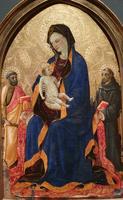
Virgem Do Leite Entre São Pedro E São Francisco
Álvaro Pires de Évora
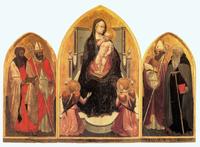
St. Juvenal Triptych
Masaccio
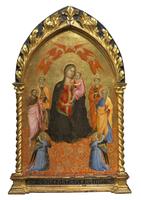
Madonna and Child with Angels and Saints
Cennino Cennini
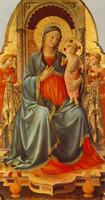
Madonna with the Child and Angels
Fra Angelico
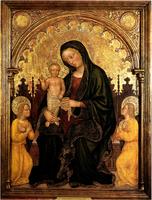
Madonna with Child and Two Angels Gentile da Fabriano
Gentile da Fabriano
Madonna Col Bambino Tra I Santi Ludovico Di Tolosa E Michele
Luca di Tommé
Virgin and Child with Sts. Louis of Toulouse and Michael
Luca di Tommé
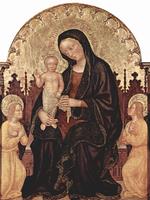
Madonna With Two Angels
Gentile da Fabriano
Virgin and Child with Sts. Dominic and Catherine of Alexandria
Fra Angelico
Madonna of Humility
Fra Angelico
Virgem Com O Menino
Álvaro Pires de Évora
Virgen Con El Niño
Álvaro Pires de Évora
Madonna of the Snow Altarpiece
Il Sassetta (Stefano di Giovanni)
Maria and Child
Masaccio
Madonna of Humility
Fra Angelico
Madonna and Child
Fra Angelico