Expert analysis of Jan van Hemessen’s Tobias Restores his Father's Sight
Style: Northern Renaissance · Genre: religious painting
Expert Analysis: "Tobias Restores his Father's Sight" by Jan van Hemessen
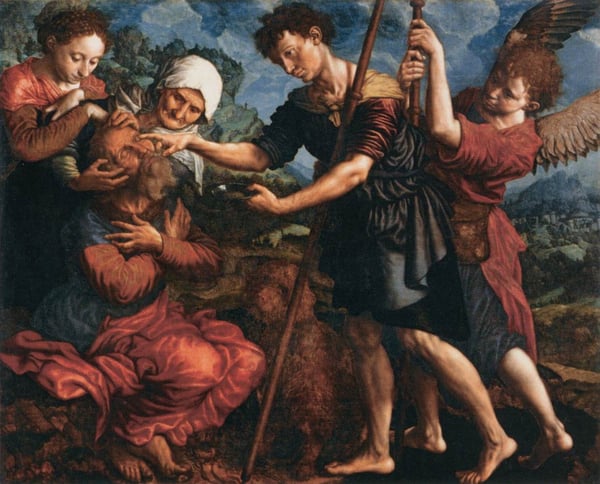
This work is a compelling example of the Northern Renaissance’s religious painting tradition, distinguished by its fusion of biblical narrative with the meticulous realism and moralizing undercurrents characteristic of Flemish art. Van Hemessen, active in Antwerp during the mid-16th century, brings the apocryphal story of Tobias and Tobit to life with a down-to-earth immediacy that elevates the scene beyond mere piety.
Significance within the Northern Renaissance
The painting’s significance lies in how it translates a miraculous event—the restoration of Tobit’s sight by his son Tobias using fish gall, guided by the archangel Raphael—into a domestic, almost clinical moment. Unlike the idealized, otherworldly depictions common in Italian Renaissance religious art, van Hemessen anchors the miracle in tangible human experience. The figures are rendered with the Northern Renaissance’s hallmark attention to texture, from the wrinkled skin of the elderly Tobit to the humble furnishings and the precise handling of the ointment. This grounding in everyday detail serves a dual purpose: it makes the divine accessible while also offering a moral lesson on filial devotion and faith.
Stylistically, van Hemessen’s composition uses a crowded, shallow space that pulls the viewer into the intimate drama. The angled heads, expressive hand gestures, and direct gazes (especially Tobias’s focused, solemn care) create a narrative of quiet concentration. The work also reflects the period’s shifting religious climate, where art increasingly addressed lay audiences through relatable, concrete imagery. Van Hemessen’s choice to emphasize the physical act of healing over celestial grandeur—the angel Raphael is present in the background, not hovering in glory—marks the painting as a pivotal example of the Northern Renaissance’s humanization of sacred stories. It is, ultimately, a testament to the era’s belief that the sacred could be found in the ordinary, and that divine truth was best illustrated through the truth of human sight and touch.
Museum / Gallery
Visually similar
20 works with related composition and palette
Noli me tangere
Lavinia Fontana
David Vencedor De Goliat
Palma il Giovane
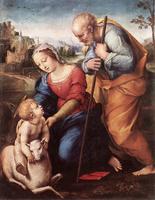
The Holy Family with a Lamb
Raphael
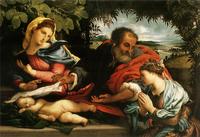
The Holy Family with St. Catherine of Alexandria
Lorenzo Lotto
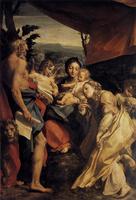
Madonna with St. Jerome (The Day)
Correggio
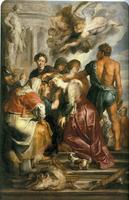
Martyrdom of St. Catherine
Peter Paul Rubens
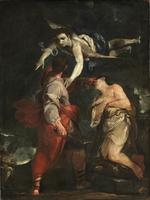
The Sacrifice of Abraham
Giuseppe Maria Crespi
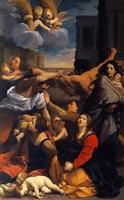
Massacre of the Innocents
Guido Reni
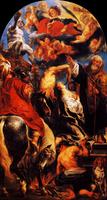
The Martyrdom of St. Apollonia
Jacob Jordaens
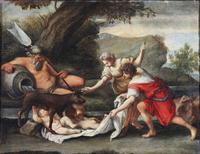
Romolo and Remo
Giovanni Francesco Romanelli
The Madonna of Saint Jerome (after Correggio)
John Graham-Gilbert
The Mystic Marriage of Sr Catherine
Paolo Veronese
Madonna and Child with St. John the Baptist and St. Jerome
Parmigianino
Abraham and the Angels
Gaspare Diziani
The Adoration of the Shepherds
Giulio Romano
The Temptation of St Anthony Abbot
Annibale Carracci
Abraham and Three Angels
Domenico Fiasella
The Reconciliation of Esau and Jacob
Peter Paul Rubens
The Triumph of David
Luca Giordano
La Virgen Y El Niño, Con Santa Isabel, San Juan Bautista Y Santa Catalina
Simon Vouet