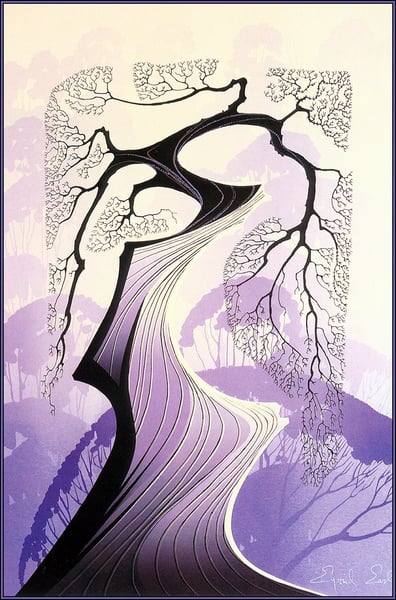
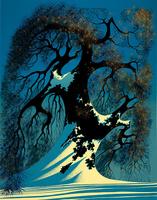
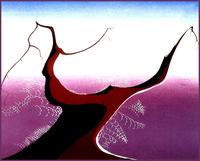
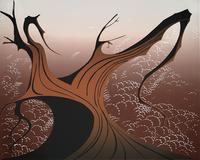
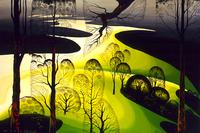
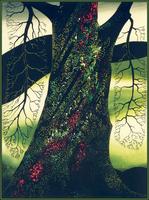
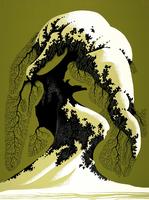
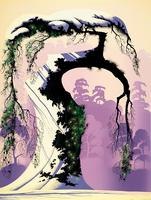
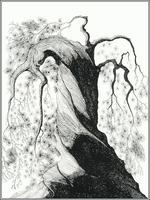
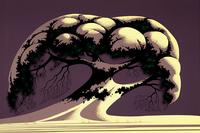
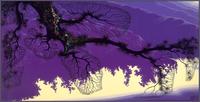
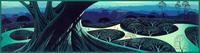
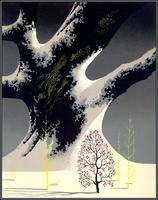
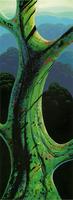
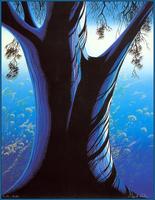
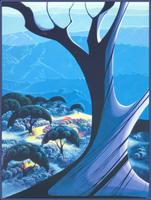
Eyvind Earle’s Carmel Cypress is a quintessential example of Magic Realism in landscape painting, a style that imbues realistic scenes with an uncanny, dreamlike clarity. Here, Earle transforms a familiar California coastal subject—a solitary cypress—into a meticulously ordered, almost otherworldly vision. The significance lies in Earle’s ability to merge the precision of a designer (drawn from his work as a Disney background artist) with a surreal, heightened sense of atmosphere. Every leaf, shadow, and contour is rendered with crystalline detail, yet the composition’s deliberate stylization—sharp contrasts, flattened planes, and an unnatural stillness—lifts the scene beyond mere documentation. This tension between the real and the imagined, typical of Magic Realism, makes the work a standout within Earle’s oeuvre and within mid-20th-century American landscape painting, as it transforms a specific locale into a timeless, enigmatic icon.