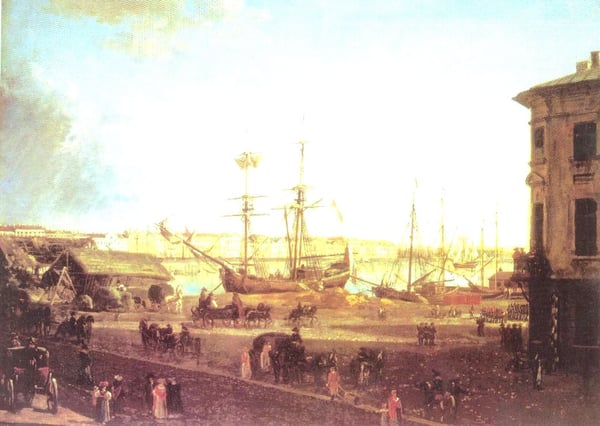
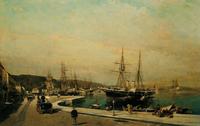
View of the English Embankmant from Visilievsky Island in St. Petersburg
Details
Expert analysis of Fyodor Alekseyev’s View of the English Embankmant from Visilievsky Island in St. Petersburg
Style: Neoclassicism · Genre: veduta
Expert Analysis: "View of the English Embankment from Vasilievsky Island in St. Petersburg" by Fyodor Alekseyev
This work is a quintessential example of the veduta genre—a precisely rendered, panoramic cityscape—executed within the framework of Neoclassicism. Its significance lies in how it perfectly marries the artistic ideals of the Neoclassical style with the specific cultural and architectural ambitions of early 19th-century St. Petersburg.
Significance within Neoclassicism and the Veduta Genre:
-
Architectural Idealization and Order: Neoclassicism prized clarity, symmetry, and a rational, harmonious composition. Alekseyev’s painting translates these principles directly onto the urban fabric. The English Embankment, with its long, unbroken line of stately palaces and government buildings, is depicted as an embodiment of Enlightenment order. The strict horizontal of the riverfront, the vertical accents of spires and columns, and the calm, expansive sky all create a balanced, almost mathematical composition. This is not merely a documentary view; it is a visual celebration of St. Petersburg as a perfectly planned Neoclassical city.
-
The Veduta as a Record of Progress: The veduta genre, famously developed by Canaletto and others, was more than a topographical record—it was a statement of civic pride and prosperity. Alekseyev adopts this tradition but applies it to Russia’s modern capital. By choosing this specific vantage point from Vasilievsky Island, he frames the embankment as a stage for the city’s grandeur. The careful rendering of architectural details—the regularity of windows, the rhythmic pilasters, the precise reflections in the Neva—demonstrates the artist’s commitment to factual accuracy, a core tenet of the veduta. Yet the selection and arrangement of these elements elevate the scene from a simple snapshot to an idealized portrait of the city’s power and sophistication.
-
A Synthesis of Russian Identity and European Style: The work is significant because it proves that Russian art could fully master a distinctly European genre while asserting a unique national identity. St. Petersburg itself was a Neoclassical project—a planned city built on European principles. Alekseyev’s veduta does not simply copy a Western model; it captures the specific Russian context: the scale of the Neva River, the particular light of the northern latitude, and the distinct style of Russian imperial architecture (such as the Admiralty or the Academy of Arts, visible in such views). This painting thus stands as a definitive visual statement of Russia’s embrace of Neoclassicism as the official language of its modern, European-facing empire.
In summary, this artwork is significant not only as a fine example of a veduta but as a Neoclassical manifesto in paint. It transforms a specific location into a symbol of rational order, imperial ambition, and artistic mastery, perfectly encapsulating the spirit of its time and place.
Visually similar
20 works with related composition and palette
View of Peterburg
Ivan Aivazovsky

Venice
Ivan Aivazovsky
Malta Valetto Harbour
Ivan Aivazovsky
A View of the Harbour, Rotterdam
Johan Jongkind
The Sun Rising Through Vapour
J.M.W. Turner
Cowes, Isle of Wight
J.M.W. Turner
The port of Volos
Konstantinos Volanakis
The Russian Squadron on the Sebastopol Roads
Ivan Aivazovsky
Moonlit Night in St. Petersburg
Maxim Vorobiev
Admiring the ships
Konstantinos Volanakis
Russian squadron on the raid of Sevastopol
Ivan Aivazovsky
Deuxième vue du port de Bordeaux
Claude-Joseph Vernet
Raid on Sevastopol
Ivan Aivazovsky
Haventafereel
Alexandre Thomas Francia
Reval
Ivan Aivazovsky
Sunset at the seashore
Konstantinos Volanakis
View of the Strada Nuova against the Giardini Pubblici in Venice
Rudolf von Alt
Night A Port in the Moonlight
Claude-Joseph Vernet
Dutch Men of War at Anchor
Simon de Vlieger
The port of Volos
Konstantinos Volanakis