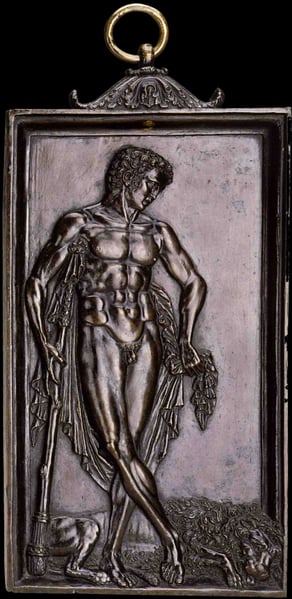
Expert analysis of Andrea Mantegna’s Hercules resting after the fight with the lion deNemee
Style: High Renaissance · Genre: sculpture
Expert Art Historical Analysis
Artwork: Hercules Resting After the Fight with the Lion deNemee (the Nemean Lion)
Artist: Andrea Mantegna (c. 1431–1506)
Style: High Renaissance
Genre: Sculpture
Although Andrea Mantegna is primarily celebrated as a painter and printmaker—famous for his rigorous perspective, archaeological precision, and emotional gravitas—this sculpture demonstrates that his talents extended into three-dimensional form, embodying the High Renaissance ideals of classical revival, anatomical naturalism, and monumental calm.
Significance within the High Renaissance:
- Classical Subject, Humanist Ideal: The choice of Hercules—specifically the moment after his first labor, wrestling the Nemean lion—reflects the Humanist fascination with heroic virtue and physical perfection. Rather than depicting the violent struggle, Mantegna captures a moment of rest, a pause that invites contemplation of strength, endurance, and triumph. This aligns with High Renaissance sculptural interests in narrative economy and psychological depth, as seen in Michelangelo’s David or Pietà.
- Anatomical Realism and Contrapposto: Mantegna’s training in perspective and his study of ancient Roman reliefs translate into a sculptural figure that, even in repose, conveys muscular tension and weight distribution. Hercules likely leans on his club or on the lion’s skin, his body in a relaxed contrapposto stance—one leg bearing weight, the other relaxed—a device revived from classical antiquity to suggest both vitality and natural ease. The careful articulation of the torso, shoulders, and limbs reflects Mantegna’s devotion to empirical observation of the human body, a hallmark of High Renaissance art.
- Influence of Antique Sculpture: Mantegna was an ardent antiquarian who collected Roman artifacts and modeled his compositions after classical sarcophagi and statues. This sculpture would have been informed by works such as the Farnese Hercules or the Belvedere Torso. The resting Hercules theme itself is a direct homage to ancient prototypes, yet Mantegna infuses it with his own rigorous, linear definition—a sculptor’s approach to surface and silhouette.
- Painterly Sensibilities in Three Dimensions: Even as a sculpture, this work evokes Mantegna’s painterly concerns: the play of light and shadow across the musculature, the restrained but expressive pose, and the sense of arrested movement. The smoothing of marble or the modeling of bronze (typical for High Renaissance small-scale statuary) would have allowed Mantegna to achieve a crisp, almost engraved finish, reinforcing the clarity of form for which he is renowned.
Significance of the Subject:
Hercules resting after the Nemean lion fight is not merely a mythological vignette; it symbolizes the Renaissance ideal of virtù—the human capacity to overcome brute force through intelligence and perseverance. By choosing this moment of quiet victory, Mantegna emphasizes inner strength over external action, a conceptual sophistication that elevates the work beyond a simple athletic study.
Conclusion:
While Mantegna’s sculptural output is rare, Hercules Resting After the Fight with the Lion deNemee stands as a testament to his mastery of classical form and his ability to translate the High Renaissance pursuit of harmony, anatomical correctness, and narrative resonance into the round. It bridges his reputation as a painter of sharp, archaeological precision with the era’s broader embrace of sculpture as a vehicle for heroic humanism.
Visually similar
20 works with related composition and palette
Revenge
Arno Breker
The Meeting of Hero and Leander
John Gibson
Other greek marble bas-relief with Hercules and Omphale, exists in the same Museum (inc F Piranesi)
Giovanni Battista Piranesi
Erotica
Chronis Botsoglou
Germanicus in the guise of Mercury
Giovanni Battista Piranesi
Apollo Belvedere
Giovanni Battista Piranesi
Erotica
Chronis Botsoglou
Statue of Caesar as a Divinity
Vincenzo Camuccini
Costume Studies with Mythological Figures for ballet “Dionysus” by Glazunov in Mordkin Theatre
Serge Sudeikin
Pedestal of the same relief (two branches)
Giovanni Battista Piranesi
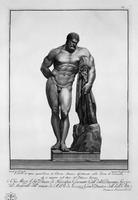
Farnese Hercules
Giovanni Battista Piranesi
Caina
Nicola Samorì
Antinous
Giovanni Battista Piranesi
Gallo`s group with his wife
Giovanni Battista Piranesi
Adán y Eva
Lorenzo Ghiberti
Three deities
Andrea Mantegna
Oedipus at Colonnos Before the Temple of the Eumenides
Anton Raphael Mengs
St. George
Giorgio de Chirico
Ganymede
Giovanni Battista Piranesi
Faun with grapes
Giovanni Battista Piranesi