Andrea Mantegna sanatçısının Samson and Delilah eseri hakkında uzman analizi
Tarz: High Renaissance · Tür: religious painting
Expert Analysis: "Samson and Delilah" by Andrea Mantegna
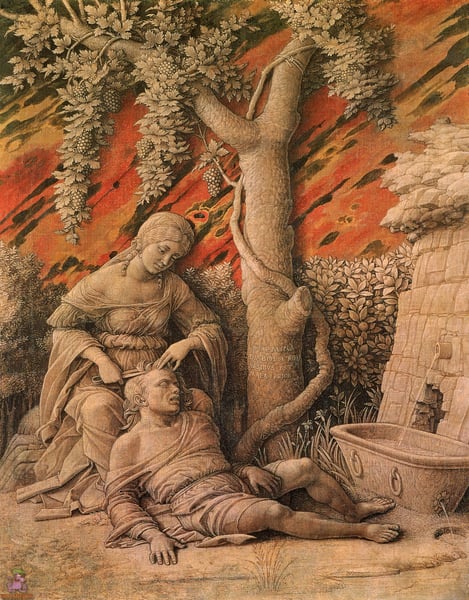
Andrea Mantegna’s Samson and Delilah stands as a compelling example of High Renaissance religious painting, distinguished by its dramatic psychological depth and rigorous classical formalism. Though Mantegna is often associated with the earlier quattrocento, this work demonstrates the High Renaissance’s mature concerns: monumental human figures, a frozen yet intensely emotional narrative moment, and a masterful use of perspective and anatomy to heighten moral and spiritual tension.
Significance within the High Renaissance Style:
-
Psychological Realism and Narrative Compression
Mantegna captures the precise instant of betrayal—Delilah has just cut Samson’s hair, the source of his divine strength. Rather than showing the struggle or aftermath, he focuses on the quiet, ominous aftermath. Delilah’s expression is ambiguous (triumph or pity?), while Samson’s slumped posture and foreshortened form convey both physical vulnerability and spiritual tragedy. This internalized drama aligns with High Renaissance ideals of expressing complex human emotion through subtle gesture and composition. -
Mastery of Foreshortening and Perspective
Mantegna’s celebrated skill in scorza (foreshortening) is on full display: Samson’s reclining body is rendered with rigorous anatomical accuracy, his head near the viewer’s plane, his legs receding into depth. The diagonals of his limbs and the scissors held by Delilah guide the eye across the canvas, creating a dynamic tension typical of High Renaissance composition (compare with Leonardo or Raphael’s use of contrapposto and pyramidal grouping). -
Classical Allusion and Moral Allegory
The painting is infused with archaeological detail—Roman armor, a stone plinth, a classical landscape—that reflects Mantegna’s lifelong passion for antiquity. Yet this classicism serves a Christian moral: the fall of a hero through sensual temptation. Delilah, draped in flowing robes that recall ancient goddesses, embodies the dangerous beauty that High Renaissance artists often used to explore themes of virtue versus vice. -
Color and Light as Emotional Tools
Mantegna employs a cool, sculptural palette—ochres, deep blues, and marble-like flesh tones—reminiscent of his passion for stone carving. The light is sharp and descriptive, modeling forms with almost metallic precision, yet it also cast a melancholy glow over the scene, reinforcing the sense of irreversible loss. This treatment of light as both natural and symbolic was a hallmark of High Renaissance visual poetry.
Why It Matters:
Samson and Delilah is significant because it bridges Mantegna’s early, linear intensity with the High Renaissance’s emotional and spatial complexity. It is not merely a biblical illustration but a meditation on power, betrayal, and the fragility of human strength—themes that resonated deeply in an era obsessed with human potential and its limits.
Museum / Gallery
Stil
Etiketler
Görsel olarak benzer
İlişkili kompozisyon ve renk paletine sahip 20 eser
Meeting of Joachim and Anne at the Golden Gate
Filippo Lippi

Penitent St. Jerome
Albrecht Altdorfer

The return of Judith to Bethulia
Sandro Botticelli
The holy family with St John
Andrea Mantegna
Love and the Maiden
John Roddam Spencer Stanhope
The Penitence of St. Jerome
Lucas Cranach the Elder
Harmony or The Three Graces
Hans Baldung
Reclining Diana
Lucas Cranach the Elder

Angel Gathering Flowers in a Heavenly Landscape (detail)
Benozzo Gozzoli
The Feast of the Gods
Titian
Venus and Mars
Sandro Botticelli
Judith and Holofernes
Andrea Mantegna
Reading of Love, He being by
Robert Bateman
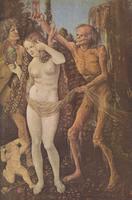
An Allegory of Death and Beauty
Hans Baldung
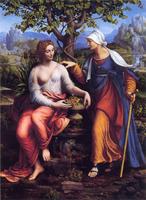
Vertumnus and Pomona
Francesco Melzi
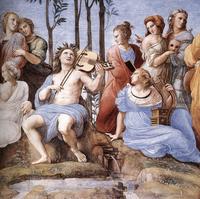
The Parnassus, from the Stanza delle Segnatura (detail)
Raphael
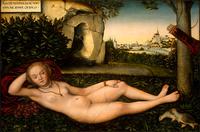
The Nymph of the Spring
Lucas Cranach the Elder
Diptych
Albrecht Altdorfer
Law and Grace
Lucas Cranach the Elder
St. Jerome Penitent
Antonello da Messina