Expertenanalyse zu Andrea Mantegnas St.Mark
Stil: Early Renaissance · Genre: religious painting
Expert Analysis: "St. Mark" by Andrea Mantegna
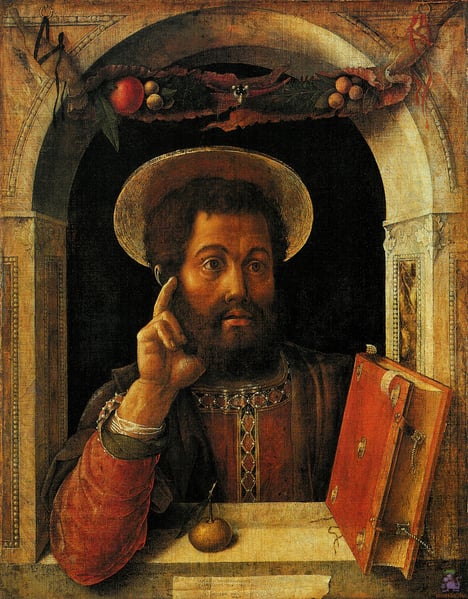
As an Early Renaissance religious painting, Andrea Mantegna’s St. Mark exemplifies the period’s revolutionary shift toward naturalism, perspective, and emotional depth within sacred subjects. Executed in the mid-15th century, the work is significant for its masterful integration of classical antiquity with Christian iconography—a hallmark of the Early Renaissance.
Mantegna’s treatment of St. Mark—typically identified by his Gospel and lion—is rooted in the era’s emphasis on humanizing saints. The figure’s robust, sculptural form and intense gaze reflect a psychological engagement uncommon in medieval religious art. Mantegna’s rigorous use of linear perspective (evident in the foreshortened scroll or architectural details) and dramatic chiaroscuro give the saint a tangible, almost three-dimensional presence, pulling the viewer into a moment of divine encounter.
The painting’s significance lies in how it bridges devotional function and innovative technique: Mantegna does not simply present a static icon but a living, authoritative evangelist. His attention to anatomical precision and classical drapery—reminiscent of Roman statues—underscores the Early Renaissance ambition to reconcile Christian faith with the rediscovered ideals of antiquity. Within the broader context of Mantegna’s oeuvre, St. Mark stands as a testament to his role in advancing the naturalistic language that would define the High Renaissance, while still serving the solemn purpose of religious instruction.
Museum / Gallery
Visuell ähnlich
20 Werke mit ähnlicher Komposition und Farbpalette
Moses
Justus van Gent
Portrait of a Man
Mabuse
Aristotle
Justus van Gent
Plato
Justus van Gent
Ritratto Di Gentiluomo
Bartolomeo Veneto
Cicerone
Justus van Gent
Portrait of Shah Ismail I
Cristofano dell'Altissimo
Saint Jerome in His Study
Filippino Lippi
Claudio Ptolomeus
Justus van Gent
Portrait of St Sebastian with an Arrow
Albrecht Durer
Ferry Carondelet with his Secretaries
Sebastiano del Piombo
Self-Portrait
Albrecht Durer
Peter II Duke of Bourbon presented by St. Peter, left hand wing of a triptych
Jean Hey
Saint Jerome in his study
Marinus van Reymerswaele
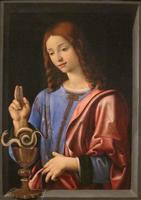
St. John the Evangelist
Piero di Cosimo
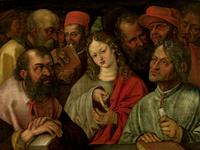
Christ Among the Doctors
Hans Hoffmann
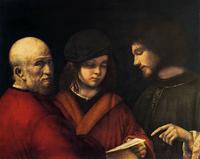
The Three Ages of Man
Giorgione
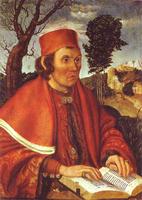
Johannes Reuss
Lucas Cranach the Elder
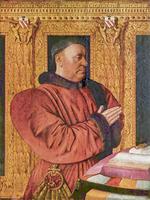
Portrait of Guillaume Jouvenel des Ursins, the Chancellor of Charles VII
Jean Fouquet
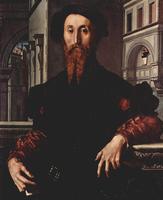
Portrait of Signor Panciatichi Bartolomeo
Agnolo Bronzino