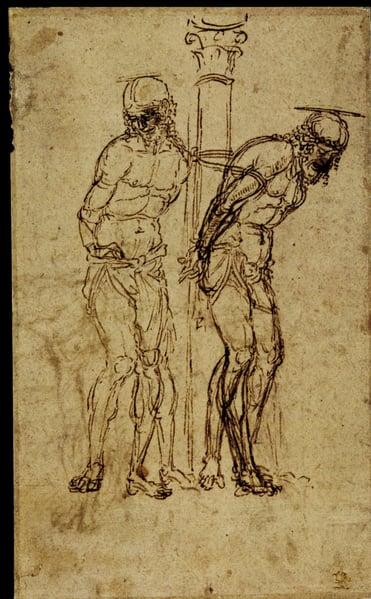
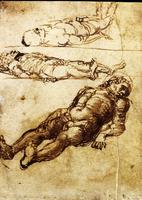
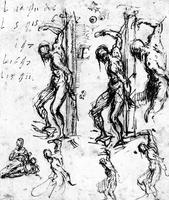
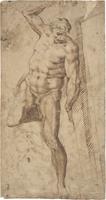
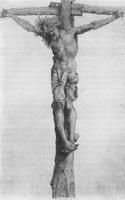
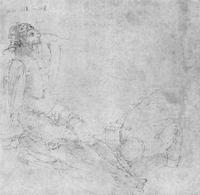
An expert analysis of Andrea Mantegna’s Two Studies for Christ at the Column must emphasize its role as an Early Renaissance sketch and study—a genre that reveals the artist’s intellectual and technical process.
As a preparatory drawing, this work exemplifies Mantegna’s rigorous approach to draftsmanship. The “two studies” likely capture multiple viewpoints or variations of Christ’s bound figure, demonstrating the artist’s concern with anatomical precision, foreshortening, and the expressive tension of a body in distress. In the context of the Early Renaissance, such studies were not mere exercises but foundational tools for composing larger religious works—here, a scene of the Flagellation. Mantegna’s style, rooted in the imitation of classical sculpture, is evident in the hard outlines and sculptural modeling of the figure, even in rapid graphite or ink strokes. The sketch’s significance lies in its direct insight into Mantegna’s workshop practice: the search for the most poignant pose to convey both physical suffering and divine pathos, a hallmark of his emotionally charged narrative art. This work also underscores the period’s shift toward humanistic observation, where artists used studies to merge naturalistic anatomy with spiritual subject matter—a defining achievement of the Early Renaissance.