Analisi esperta di The four horsemen of the Apocalypse di Arturo Souto
Stile: Expressionism · Genere: religious painting
Expert Analysis: "The Four Horsemen of the Apocalypse" by Arturo Souto
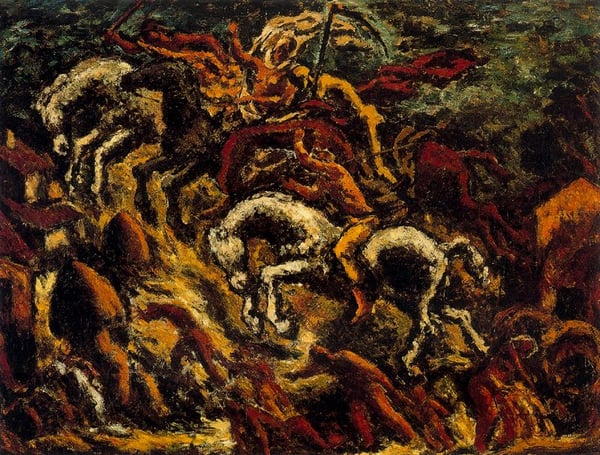
Arturo Souto's The Four Horsemen of the Apocalypse stands as a compelling intersection of Expressionist intensity and religious iconography. Executed within the Expressionist style, the work transcends traditional biblical illustration by channeling the raw, subjective emotion that defines the movement. The apocalyptic theme—drawn from the Book of Revelation, depicting Conquest, War, Famine, and Death—is rendered not as a historical or doctrinal scene, but as a visceral, contemporary allegory of human suffering.
What makes this work significant is its ability to harness Expressionism’s hallmark distortions—exaggerated forms, jarring brushwork, and heightened, often dissonant color—to amplify the psychological dread of the narrative. Souto moves beyond mere illustration; the horsemen become embodiments of collective anxiety, their horsemen likely depicted with angular, agitated lines that convey a world in turmoil. This is typical of Expressionism’s rejection of naturalistic beauty in favor of emotional truth, and here it serves the religious genre by making the spiritual horror of the Apocalypse deeply personal and immediate.
In the context of religious painting, Souto’s work is notable for modernizing a medieval and Renaissance subject. Rather than a calm, ordered vision of divine judgment (as in earlier traditions), the painting reflects the angst of the 20th century—a period marked by war, upheaval, and existential crisis. By fusing a timeless biblical story with an avant-garde, emotionally charged visual language, Souto demonstrates how religious art can evolve to speak to modern fears. The work thus becomes a powerful bridge between traditional sacred themes and the expressive, subjective turn in modern art.
Visivamente simili
20 opere con composizione e palette affini
War
Arnold Böcklin
Horses on the run
Giorgio de Chirico
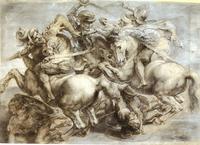
Copy of Battle of Anghiari, the lost painting by Leonardo da Vinci
Peter Paul Rubens
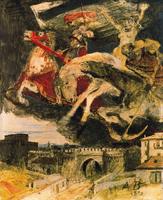
Study to 'War'
Arnold Böcklin
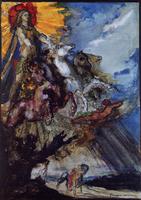
Phoebus and Boreas
Gustave Moreau
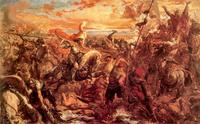
Varna
Jan Matejko
The battle of Issus(fragment)
Albrecht Altdorfer
The Inferno, Canto 12
Gustave Dore
Esquisse pour Automédon avec les chevaux d'Achille
Henri Regnault
Arabs. Study for 'The Battle of Tetuan'
Salvador Dali
The Conversion of St. Paul
Adam Elsheimer
Pentesilea
Arturo Michelena
Jan III at Vienna
Jan Matejko
The death of Leszek the White
Jan Matejko
Saint George
Odilon Redon
Horsemen
Rudolf Láng
The Battle of Giaour and Hassan
Eugene Delacroix
Copy of a Rubens Copy of a Leonardo
Salvador Dali
Cavalier over a fallen adversary
Titian
Fallen horse
Giorgio de Chirico