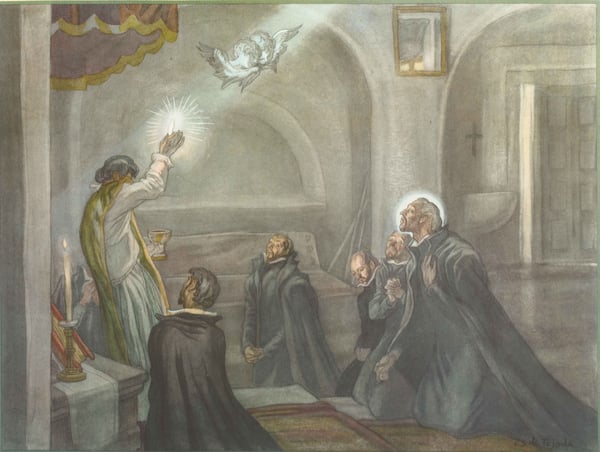
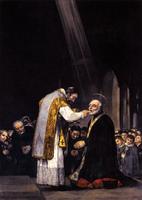
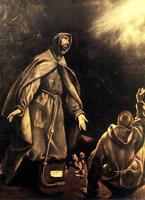
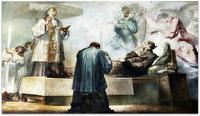
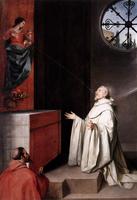
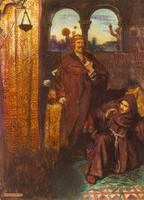
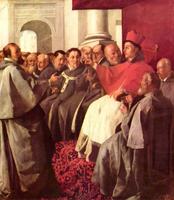
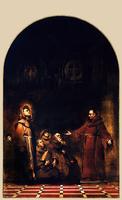
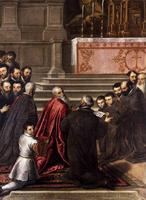
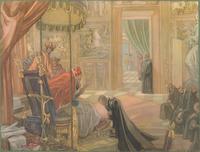
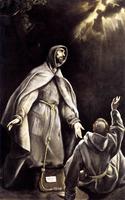
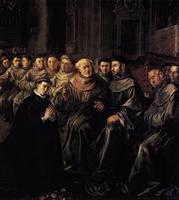
This artwork—"The Life of St. Ignatius Loyola. Plate 5. Ignatius and the first companions take vows at Montmartre 15th August 1534" by Carlos Saenz de Tejada—is significant as an intriguing intersection of Art Nouveau (Modern) aesthetics with a traditional history painting subject.
Art Nouveau is typically associated with sinuous, organic lines, decorative floral motifs, and a celebration of modern life, yet here it is applied to a solemn, historically charged religious scene: the founding moment of the Society of Jesus (the Jesuits) in 1534. Saenz de Tejada merges the period’s characteristic whiplash curves and elegant, stylized composition with the gravity of a sacred vow-taking.
The work’s significance lies in its synthesis of sacred history and modernist design. Instead of a naturalistic or baroque treatment of the subject, the artist employs a flattened, decorative space—likely with rhythmic outlines and harmonious colour planes—that elevates the scene from mere documentation to a symbolic, almost iconic representation. This approach was part of a broader early-20th-century trend to revitalize religious art through contemporary styles, making the narrative feel both timeless and modern.
As a plate in a series, the piece also demonstrates how Art Nouveau could serve narrative cycles, balancing narrative clarity with the period’s emphasis on aesthetic surface and ornamental unity. It stands as a testament to the adaptability of modern visual language to historical and spiritual themes.