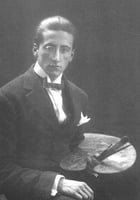
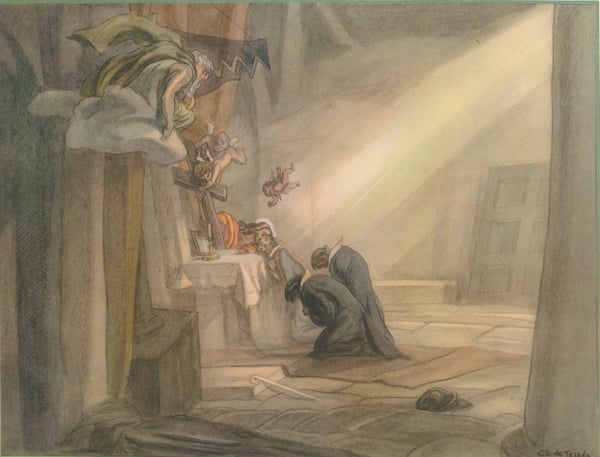
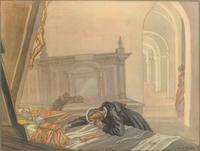
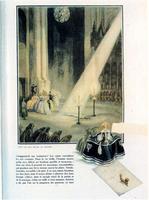
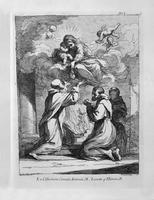
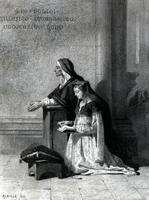
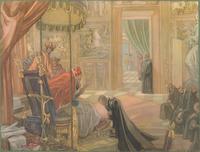
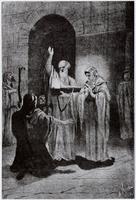
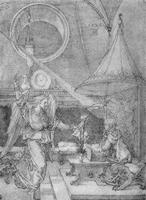
This work by Carlos Saenz de Tejada is a significant hybrid that bridges the decorative fluidity of Art Nouveau with the narrative gravitas of history painting. Executed as “Plate 6” in a series on St. Ignatius Loyola, it records the vision at La Storta—a pivotal moment in Jesuit history. While Art Nouveau typically eschewed overt religiosity in favor of organic, sensual forms, Saenz de Tejada reinterprets the saint’s spiritual experience through the style’s characteristic sinuous lines and flattened, patterned spaces. The result is a modernized hagiography: the mystical encounter becomes less a literal miracle and more a rhythmic, almost musical composition. This fusion underscores how Art Nouveau artists could update centuries-old iconography for a contemporary audience, preserving the sacred subject while injecting it with the period’s aesthetic of elegant, continuous movement. The work’s significance lies in its demonstration that even a traditional history-painting genre could be revitalized without losing its devotional core—a subtle but telling innovation within early 20th‑century modernism.