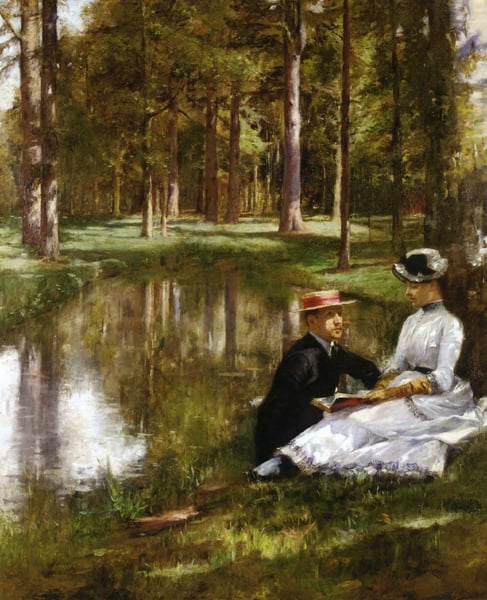
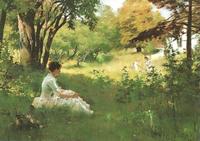
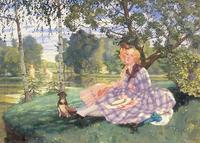
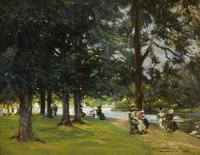
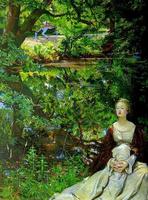
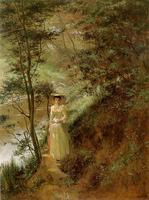
"Reading" by Julius LeBlanc Stewart exemplifies the artist’s distinctive blend of Impressionism and Realism, capturing a quiet moment of private leisure with the refined elegance characteristic of his work. Stewart, an American expatriate long based in Paris, was celebrated for his depictions of the leisure class, and this genre painting of a woman absorbed in a book demonstrates his ability to infuse a seemingly ordinary scene with sophisticated charm.
What makes this work significant is Stewart’s skillful synthesis of two movements: from Impressionism, he borrows a luminous, atmospheric palette and a sense of fleeting, spontaneous light, while from Realism he inherits a precise, almost photographic clarity of detail and a solid, anchored composition. The subject’s relaxed pose and the soft, dappled light that falls across her dress and page suggest a moment stolen from time—an intimate portrait of contemplation that feels both modern and timeless.
As a member of the American expatriate community in France, Stewart often painted the social elite in their domestic environments, and "Reading" is no exception. The painting’s significance lies in how it elevates a daily ritual to the status of fine art, bridging the gap between plein-air impressionism’s focus on light and the academic tradition’s respect for figure and narrative. It offers a window into the cultivated life of the Gilded Age, while its handling of light and texture places it firmly within the Impressionist idiom.