
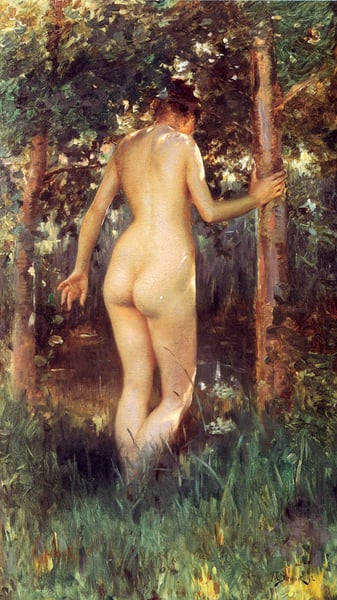
Expertenanalyse zu Julius LeBlanc Stewarts Study Of A Nude Woman
Stil: Academicism, Realism · Genre: nude painting (nu)
Expert Art Historical Analysis: "Study Of A Nude Woman" by Julius LeBlanc Stewart
Julius LeBlanc Stewart (1855–1919), an American-born artist who spent most of his career in Paris, was a leading figure in the late 19th-century Academic and Realist traditions. This painting, Study Of A Nude Woman, exemplifies the intersection of rigorous academic training and the emerging naturalist impulse that defined the era's finest figure painting.
Significance within Academicism and Realism
The work is a masterful demonstration of the academic method, which prized the human figure as the ultimate subject. Stewart, a pupil of the renowned Jean-Léon Gérôme, inherited a precise draftsmanship and a commitment to anatomical accuracy. Here, the nude is not merely a classical ideal but a carefully observed, living model—a hallmark of Realism’s insistence on truth to nature. The “study” format itself is significant: it foregrounds the artist’s process, emphasizing meticulous value gradations, subtle skin tones, and the play of light across the body, rather than narrative or allegorical content. This aligns with the academic practice of dessin (drawing) as the foundation of art, while also reflecting the Realist shift away from idealized nudes toward individual, unidealized human forms.
Context and Artistic Value
Stewart’s Study occupies a crucial transitional space. Unlike the polished, mythological nudes of earlier Academicism, this figure is presented with a directness and naturalism that recalls the work of contemporaries like Jean-Jacques Henner or the early Realist nudes of Gustave Courbet (though without Courbet’s social provocation). The palette is restrained, emphasizing flesh tones and chiaroscuro, focusing attention on the structure and mass of the body. The pose is understated, avoiding theatricality, which allows the viewer to appreciate the artist’s skill in rendering human anatomy without contrivance. As a study, it also offers insight into Stewart’s working method—likely a preparatory work for a larger composition—yet it stands on its own as a testament to the enduring academic tradition of disciplined observation.
Legacy
In the context of late 19th-century art, when Impressionism and Post-Impressionism were challenging academic norms, Stewart’s Study Of A Nude Woman reaffirms the continued vitality of academic realism. It reminds us that the finest academic works were not stiff or lifeless, but animated by a profound sensitivity to the human form. Its significance lies in its quiet perfection: a fusion of the academic ideal of form with the realist’s fidelity to the individual, making it a compelling document of a painter at the height of his technical powers.
Museum / Gallery
Visuell ähnlich
20 Werke mit ähnlicher Komposition und Farbpalette
Nymphs of Nysa
Julius LeBlanc Stewart
Sunlight
Julius LeBlanc Stewart

Red sand
Anders Zorn
Nude under a fir
Anders Zorn
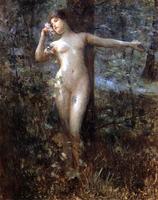
Nude in the Forest
Julius LeBlanc Stewart
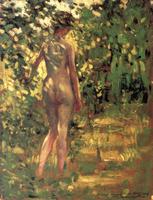
Nude in a Glade
Frederick Carl Frieseke
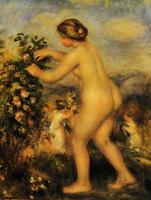
Ode to Flowers (after Anacreon)
Pierre-Auguste Renoir
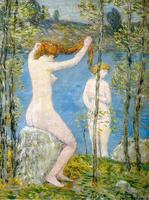
Untitled (Study for 'Bathers')
Childe Hassam
Numph Bathing
Childe Hassam
Seated Bather
Pierre-Auguste Renoir
At the source (the nymph in the woods)
Giovanni (Nino) Costa
Nude
Edward Henry Potthast
The Laughing Maid
Julius LeBlanc Stewart
Half length study of a boy
Henry Scott Tuke
Red Stockings
Anders Zorn
Nude with Peach Blossoms
Fujishima Takeji
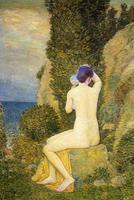
Aphrodite, Appledore
Childe Hassam
A Woodland Bather
Henry Scott Tuke
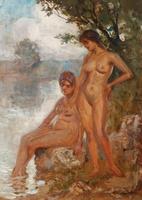
Baigneuse
Nicolae Vermont
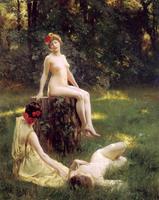
The Glade
Julius LeBlanc Stewart