Expert analysis of Julius LeBlanc Stewart’s The Glade
Style: Academicism, Realism · Genre: nude painting (nu)
Expert Analysis: "The Glade" by Julius LeBlanc Stewart
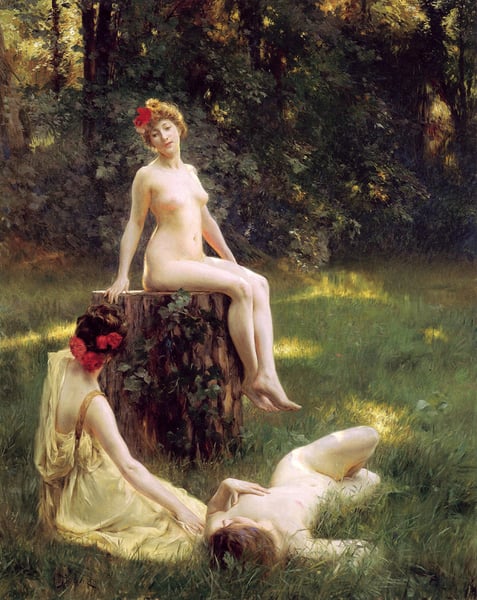
Julius LeBlanc Stewart (1855–1919), an American expatriate painter who spent most of his career in Paris, was a master of both Academicism and Realism—two movements that often intersected in late-19th-century French salon painting. "The Glade" (a nude painting, or nu) exemplifies this synthesis, demonstrating Stewart’s ability to merge classical idealization of the human form with a naturalistic, unposed observation of light and landscape.
Significance within Style and Period:
- Academic Precision Meets Realist Observation: Stewart renders the nude figures with the smooth, polished modeling and anatomical correctness demanded by Academic tradition. Yet he avoids the stiff, mythological artifice typical of earlier academic nudes; instead, the figures seem to breathe in a real, identifiable forest glade. The dappled sunlight filtering through leaves, the varied greens and earthy browns, and the subtle texture of the ground reflect a Realist commitment to capturing transient effects of atmosphere and light.
- Synthesis of the Ideal and the Everyday: Unlike many academic nudes posed in studio settings or theatrical landscapes, Stewart’s figures inhabit a space that feels immediate—almost like a candid moment of leisure. This aligns with the late-19th-century turn toward naturalism, where artists like Stewart sought to dignify contemporary outdoor life (a theme also explored by the Impressionists, though Stewart retains a more finished, polished surface).
- Cultural and Social Context: Stewart was known for depictions of fashionable society and leisurely moments. "The Glade" may be read as an idealized vision of a pastoral idyll, popular among affluent patrons who prized refined sensuality without overt vulgarity. The work’s balanced composition and harmonious color palette ensure it remains decorous, while the unidealized treatment of the forest setting roots it in reality—a hallmark of the hybrid Academic-Realist style that appealed to both conservative critics and progressive viewers.
What Makes It Significant:
"The Glade" stands as a refined example of how Academicism and Realism could coexist, demonstrating that rigorous draftsmanship need not preclude a fresh, immediate encounter with nature. Stewart’s ability to orchestrate a luminous, sun-dappled scene while maintaining anatomical precision elevates the work beyond mere nude study; it becomes a meditation on light, flesh, and landscape—a quiet but accomplished statement of late-19th-century painting’s expanding boundaries.
Museum / Gallery
Visually similar
20 works with related composition and palette
Sunlight
Julius LeBlanc Stewart
The Laughing Maid
Julius LeBlanc Stewart
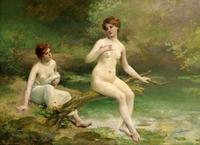
Les Deux Baigneuses
Jules-Frédéric Ballavoine
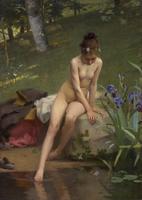
The Little Shepherdess
Paul Peel
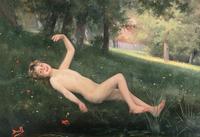
Naked girl in the forest
Joan Brull
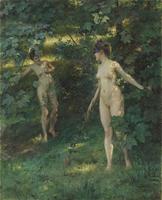
Nymphs of Nysa
Julius LeBlanc Stewart
Nu Sur La Plage
Guillaume Seignac
Nudes in the Woods
Emmanuel Benner
In the Forest
Guillaume Seignac
Nymphs in the Forest
Paul Quinsac
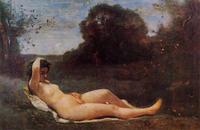
Reclining Nymph
Camille Corot
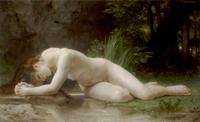
Biblis
William-Adolphe Bouguereau
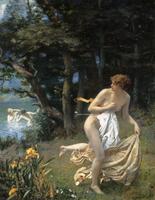
Diana's Maidens
Edward Robert Hughes
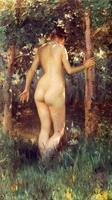
Study Of A Nude Woman
Julius LeBlanc Stewart
Fragrant Iris
Guillaume Seignac
The Bathers
Robert Lewis Reid
Bathers in the forest
Pierre-Auguste Renoir
The Judgment of Paris
Solomon Joseph Solomon
At the source (the nymph in the woods)
Giovanni (Nino) Costa
Beauty preparing to bathe
Konstantin Makovsky