Expert Analysis of Sunlight by Julius LeBlanc Stewart
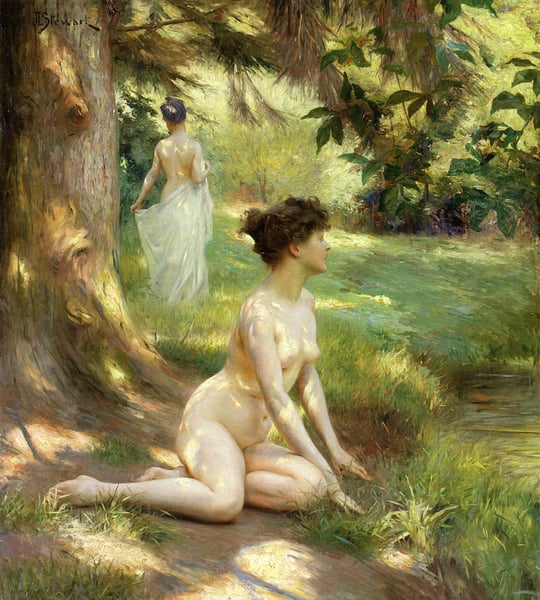
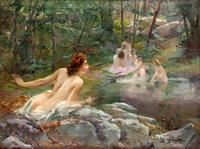
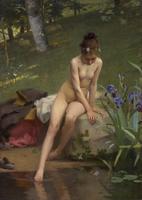
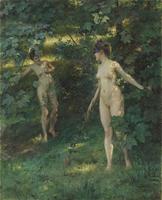
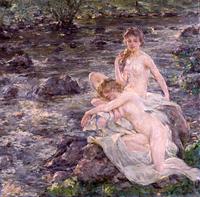
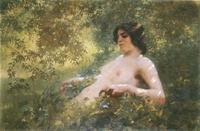
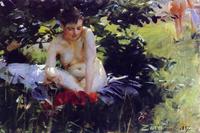
Julius LeBlanc Stewart’s Sunlight is a striking example of late 19th-century painting that bridges the technical polish of Academicism with the observational honesty of Realism. Executed in the nude (nu) genre, the work derives its significance from its synthesis of two seemingly opposing approaches: the disciplined composition and idealized form championed by academic tradition, and the Realist commitment to rendering the figure in natural, unidealized light.
The title itself signals Stewart’s Realist intent—by focusing on the effect of sunlight on the human body, he moves beyond the studio-bound, artificially lit nudes typical of academic painting. Instead, he applies rigorous academic draftsmanship to capture the play of natural illumination across skin, creating a sense of immediacy and truth. This fusion was pivotal in the period, as it allowed artists to honor classical standards of beauty while embracing modernity’s demand for authenticity.
Within the context of Academicism and Realism, Sunlight stands as a testament to Stewart’s ability to update the nude tradition—a genre often mired in allegory or mythology—by situating it in a believable, luminous environment. The work thus marks a key moment where technical virtuosity serves not decoration, but a fresh, naturalistic vision.