
Analisi esperta di Red Dog di Gene Davis
Stile: Color Field Painting · Genere: abstract
Expert Analysis: “Red Dog” by Gene Davis
Artwork: “Red Dog”
Artist: Gene Davis
Style: Color Field Painting
Genre: Abstract
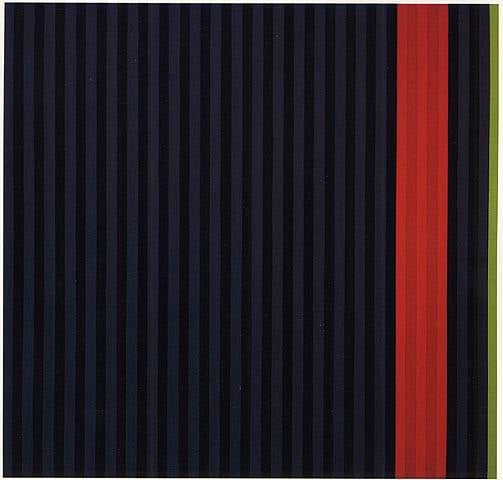
“Red Dog” exemplifies the core tenets of Color Field painting, a movement that emerged in the 1950s–60s and prioritized large fields of flat, unmodulated color as the primary vehicle for expression. Gene Davis, a leading figure of the Washington Color School, is best known for his signature vertical stripe compositions—and “Red Dog” is a quintessential example.
Significance within Color Field Painting:
-
Purity of Color as Subject – In “Red Dog,” Davis eliminates all figurative references, narrative, and gestural brushwork. The painting’s sole focus is the interaction of saturated hues. Unlike earlier Abstract Expressionists, Davis does not use color to convey emotion through mark-making; instead, he presents color as a physical, optical phenomenon. The title “Red Dog” may allude to a personal memory or a visual trigger, but the work itself remains rigorously abstract, letting the chromatic relationships generate meaning.
-
Rhythm and Repetition through Stripes – Davis’s characteristic use of evenly spaced vertical bands creates a hypnotic, all-over composition. In “Red Dog,” variations in stripe width and hue (likely including reds, pinks, oranges, and perhaps contrasting accents) produce a pulsating rhythm. This repetition is not monotonous—it invites the viewer’s eye to scan, linger, and discover subtle shifts in temperature and intensity. The stripe format became Davis’s hallmark, allowing him to explore how adjacent colors affect one another, a key concern of Color Field theory.
-
Optical Dematerialization – Color Field painters like Davis sought to dissolve the distinction between figure and ground. In “Red Dog,” the stripes appear to float or vibrate against the canvas surface. The viewer’s perception is actively engaged: complementary or near-complementary colors may create afterimages or a sense of depth without illusionistic space. This optical “push-pull” effect—pioneered by artists such as Hans Hofmann and later refined by Washington Color School members—marks the work’s significance as a study in pure visual sensation.
-
Scale and Immersion – Although specific dimensions of “Red Dog” are not provided, Gene Davis’s canvases are frequently large, intended to envelop the viewer. When encountered at full scale, a painting like “Red Dog” becomes a color environment. This immersive quality aligns with the Color Field ambition to create a direct, physical encounter with color, bypassing intellectual interpretation in favor of raw sensory experience.
Conclusion:
“Red Dog” is significant because it distills the Color Field project to its essence: color as structure, color as perception, color as experience. Davis’s systematic yet lyrical use of stripes makes the painting a landmark of the Washington Color School, demonstrating how repetition and chromatic nuance can yield a vast, contemplative field of energy. For students of abstract art, “Red Dog” offers a masterclass in the power of simplicity and the infinite variations possible within a constrained formal language.
Visivamente simili
20 opere con composizione e palette affini
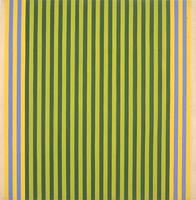
Limelight/Sounds of Grass
Gene Davis
Licorice Stick
Gene Davis
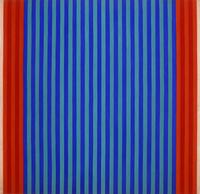
Untitled
Gene Davis
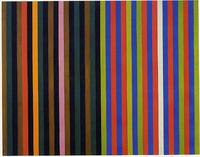
Yankee Doodle
Gene Davis
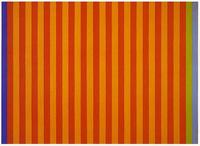
Edges/Solar Beat
Gene Davis
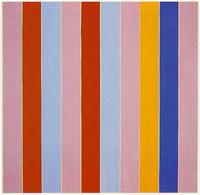
Peeping Wall
Gene Davis
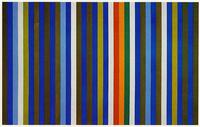
Citadel
Gene Davis
Flower Machine
Gene Davis
Orange Twitter
Gene Davis
Parallèles bleues
Guido Molinari
Circus Sounds
Gene Davis
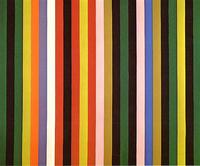
Ferris Wheel
Gene Davis
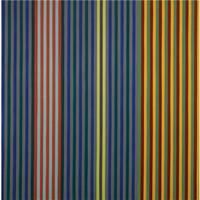
Split Beat
Gene Davis
Moroccan Midnight
Gene Davis
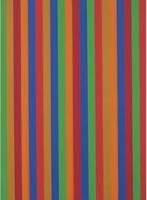
Mutation Mathematique Vert-Ocre
Guido Molinari
Zebra
Gene Davis
Voodoo
Gene Davis
Red Baron
Gene Davis

Gothic Jab
Gene Davis
V.S.
Karl Benjamin