
Analisi esperta di Licorice Stick di Gene Davis
Stile: Color Field Painting · Genere: abstract
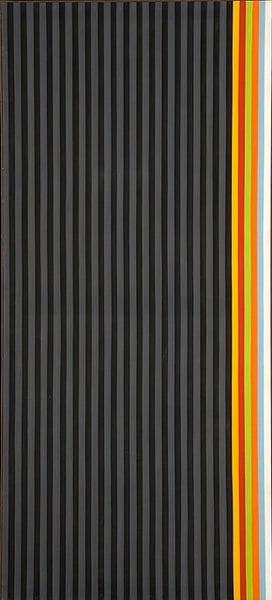
"Licorice Stick" by Gene Davis exemplifies the core principles of Color Field Painting, a movement that emerged in the mid-20th century as a radical departure from Abstract Expressionism's gestural intensity. Davis, a leading figure of the Washington Color School, is renowned for his signature use of repetitive vertical stripes, and this work is a quintessential example of his mature style.
Significance within Color Field Painting:
-
Pure Optical Experience: Davis reduces painting to its most fundamental element—color. In "Licorice Stick," the titular "licorice" likely refers to a bold, deep black or very dark stripe, which acts as a visual anchor among vibrating bands of bright, saturated hues. This creates a pulsating optical effect that engages the viewer's retina directly, prioritizing sensory perception over narrative or symbolism. The painting becomes an immersive field of color that seems to extend beyond the canvas edges.
-
Rejection of Compositional Hierarchy: Unlike traditional painting that directs the eye to a central focal point, Davis's evenly spaced, uniformly scaled stripes abolish any single point of interest. The composition is deliberately flat and "all-over," aligning with Color Field's goal of presenting a unified, non-hierarchical picture plane. This challenges the viewer to scan horizontally, often inducing a rhythmic, almost musical sensation—a trait that links his work to the syncopation of jazz (a recurring theme in his titles, such as Black Grey Beat or Red Jazzy).
-
Minimalism within Abundance: While the stripes appear simple, their arrangement is carefully calibrated. The width of each stripe, the intervals between them, and the interplay of warm and cool tones create a dynamic tension. "Licorice Stick" likely pushes this tension to an extreme: a stark, dark stripe against a field of bright colors forces a dialogue between saturation and void, embodying the Color Field interest in how adjacent colors affect one another (simultaneous contrast). This makes the work a study in optical perception—a key concern for Davis and his contemporaries like Kenneth Noland and Morris Louis.
-
Expansion of the Canvas: True to Color Field, the paint is typically stained into unprimed canvas, eliminating brushwork and emphasizing the flatness of the support. The stripes seem to soak into the fabric, making the color itself the subject rather than an applied layer. This technique, combined with the repetitive structure, underscores the painting's existence as an object, not a window.
In summary, "Licorice Stick" is significant for its rigorous distillation of color into a direct, perceptual experience. It epitomizes how Color Field painters like Gene Davis used systematic repetition and optical effects to strip painting down to its essential vocabulary: pure color and surface, inviting a contemplative, almost meditative engagement that defined the movement's legacy.
Visivamente simili
20 opere con composizione e palette affini
Untitled
Gene Davis
Limelight/Sounds of Grass
Gene Davis

Gothic Jab
Gene Davis
Red Dog
Gene Davis
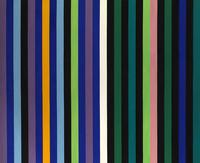
Two Part Blue
Gene Davis
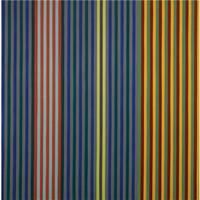
Split Beat
Gene Davis
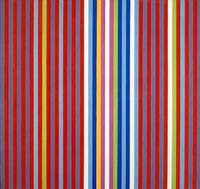
Pepper Pot
Gene Davis
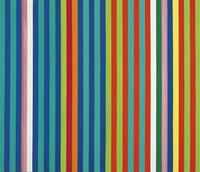
Orange Twitter
Gene Davis
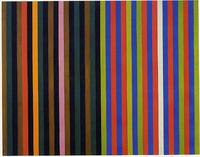
Yankee Doodle
Gene Davis
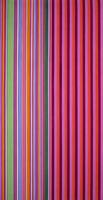
Red Baron
Gene Davis
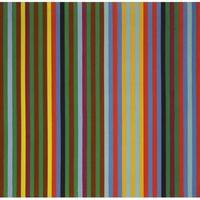
Circus Sounds
Gene Davis
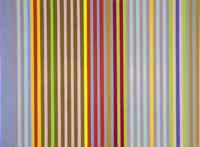
Apricot Ripple
Gene Davis
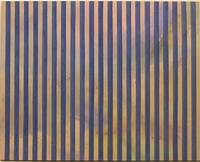
Untitled
Gene Davis
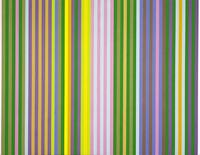
Zebra
Gene Davis
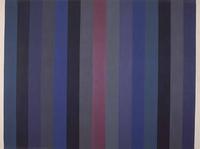
Voodoo
Gene Davis
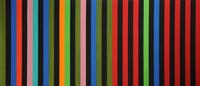
Firebox
Gene Davis
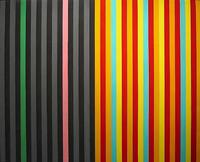
Hot Susan
Gene Davis
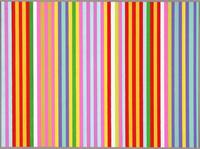
Powwow
Gene Davis
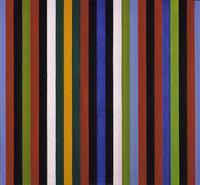
Hot Beat
Gene Davis
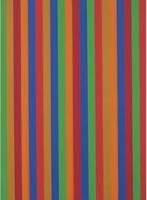
Mutation Mathematique Vert-Ocre
Guido Molinari