
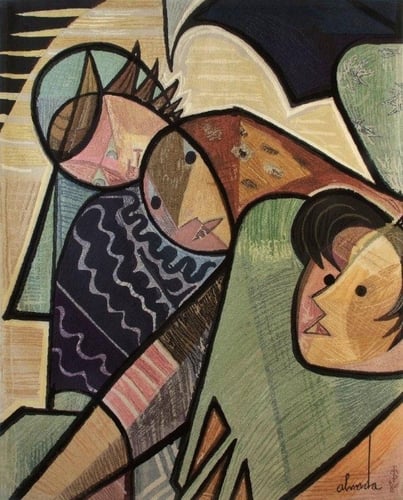
Fisherwoman, tapestry
Expert analysis of Jose de Almada-Negreiros’s Fisherwoman, tapestry
Style: Cubism · Genre: portrait
Expert Analysis of "Fisherwoman, tapestry" by José de Almada-Negreiros
José de Almada-Negreiros (1893–1970) was a central figure in Portuguese modernism, and his Fisherwoman tapestry stands as a striking example of how Cubism—a movement typically associated with French painting—was adapted to local materials, subjects, and craftsmanship. This work is significant for its synthesis of Cubist principles with a distinctly Portuguese identity, rendered through the tactile, labor-intensive medium of tapestry.
Stylistic Significance within Cubism
Almada-Negreiros employs the hallmark Cubist strategies of geometric fragmentation, multiple perspectives, and the flattening of pictorial space. The fisherwoman’s figure is broken into faceted planes—her face shown simultaneously in profile and three-quarter view, her body reduced to angular, interlocking shapes. Unlike the muted earth tones of early Analytic Cubism (Picasso, Braque), Almada-Negreiros introduces strong, contrasting colors—deep blues, ochres, and reds—that evoke the Atlantic coast and the folk traditions of Portugal. This chromatic boldness aligns with the later, more decorative Synthetic Cubism, yet retains a raw, expressive energy.
Medium and Materiality
The choice of tapestry is crucial. By translating Cubist abstraction into a woven textile, Almada-Negreiros bridges high modernism and vernacular craft. Tapestry’s inherent grid structure (the warp and weft) parallels Cubism’s interest in planar construction, while its dense, tactile surface emphasizes the artist’s departure from traditional oil painting. This work can be seen as a response to the Renaissance du métier in early 20th-century Portugal, where artists sought to elevate decorative arts. The rough, hand-woven texture also mirrors the rugged life of the fisherwoman, grounding the intellectual rigor of Cubism in everyday reality.
Portrait and National Identity
Fisherwoman is not merely a formal exercise; it is a portrait that defines a national archetype. Almada-Negreiros, a member of the Orpheu generation, sought to modernize Portuguese art without losing its roots. The subject—a working-class woman from the coastal communities—represents the authentic, unsentimental soul of the nation. The Cubist decomposition does not dehumanize her; rather, it re-presents her resilience through a fractured, dynamic form that suggests movement, labor, and endurance. The tapestry format further aligns her with traditional Portuguese tapetes de Arraiolos and colchas, asserting that modernist innovation can spring from local heritage.
Conclusion
In Fisherwoman, tapestry, Almada-Negreiros achieves a rare fusion: Cubism’s radical visual language becomes a vessel for Portuguese cultural identity, and tapestry—once relegated to craft—is elevated to high art. This work stands as a testament to the global reach of Cubism, proving its adaptability beyond the Parisian avant-garde. It remains significant for its contribution to the modernist redefinition of national art, and for its bold, woven testimony to the dignity of ordinary people seen through a revolutionary lens.
Visually similar
20 works with related composition and palette

Seated woman
Pablo Picasso
Scheiber Hugó, Varieté
Scheiber Hugó

Harlequin's family
Pablo Picasso

Artist and his model
Pablo Picasso

Seated Woman
Pablo Picasso

Discovery of Time
George Stefanescu

Buste of young woman (Marie-Therese Walter)
Pablo Picasso

Femme au Fauteuil
Albert Gleizes

Untitled (JSP136)
Janet Sobel

Seated woman (Jacqueline)
Pablo Picasso

The Touch
Evan Magar

Untitled
Pablo Picasso

Lovers (The kiss)
Ernst Ludwig Kirchner

Frank O'Hara, 1926-1966
Grace Hartigan

Woman sitting in an armchair
Pablo Picasso

Woman turned right
Pablo Picasso

Untitled
Pablo Picasso

Woman by the window
Pablo Picasso

Untitled
Janet Sobel

Scheiber Hugó, Hölgy
Scheiber Hugó