
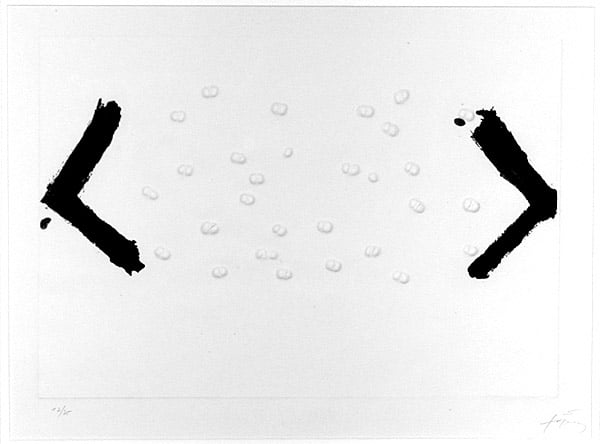
Expert analysis of Antoni Tapies’s Les Haricots
Style: Art Informel · Genre: abstract
Expert Analysis: "Les Haricots" by Antoni Tàpies
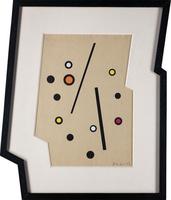
As a leading figure of Art Informel—the European post-war counterpart to American Abstract Expressionism—Antoni Tàpies created works that radically redefined painting by fusing materiality with metaphysical depth. "Les Haricots" (French for "The Beans") exemplifies his signature approach: an abstract composition that transforms humble, everyday matter into a profound meditation on existence.
Style and Context
Art Informel (or "unformed art") rejected geometric abstraction in favor of spontaneous, gestural, and often tactile surfaces. Tàpies pushed this further through his materic painting (pintura matérica), where he mixed marble dust, sand, clay, and even found objects into his pigment. The result is a thick, crust-like texture that resembles weathered walls, archaeological fragments, or organic residues. "Les Haricots" belongs to this phase, where the canvas becomes a field of physical experience rather than mere illusion.
Significance within the Work
The title "Les Haricots" is deliberately mundane, referencing dried beans—a staple of poverty and sustenance in post-Civil War Spain. Tàpies elevates this trivial object by abstracting it into a grid of organic, bean-shaped forms embedded in a rough, monochromatic surface. The beans are both present and dissolved: they are palpable lumps in the paint, yet they merge with the ground, suggesting decay, transformation, or the cycle of life. This ambiguity is central to Tàpies’ philosophy: matter carries memory, and the banal can become sacred.
Artistic Importance
- Material as Metaphor: Unlike pure gestural abstraction (e.g., Pollock), Tàpies’ work insists on the thingness of painting. The scratched, incised, and built-up surface in "Les Haricots" evokes walls, doors, and scars—linking personal trauma (the artist’s long illness and exile) to collective history (Spanish repression, war).
- Everyday Transcendence: By naming a work after beans, Tàpies challenges the hierarchy of subject matter. The ordinary becomes a vessel for cosmic or existential reflection, echoing Zen philosophy and his interest in Eastern thought.
- Tactile Aesthetics: The viewer is drawn to touch the picture (though forbidden), creating an almost physical empathy. This haptic quality distinguishes Tàpies from contemporaries and prefigures later installation and process art.
Conclusion
"Les Haricots" is significant because it condenses the core tenets of Art Informel: anti-formal, emotionally charged, and deeply rooted in material reality. Tàpies turns the simplest of objects into a site of resistance—against aesthetic decorum, against forgetfulness—and insists that meaning arises from the raw stuff of existence. The work remains a landmark in post-war European abstraction, where the canvas is no longer a window but a scarred, living surface.
Visually similar
20 works with related composition and palette
Weisse Struktur, Zufallsverteillung II
Gerhard von Graevenitz
Untitled
Gene Davis
Deep Six
Gene Davis
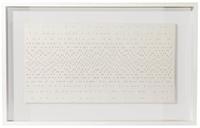
Weiße Struktur
Gerhard von Graevenitz
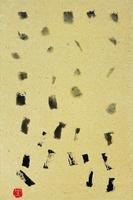
Epitaph
Se-Ok Suh
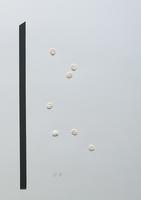
2035 Stadt & Schnee
MF ARLO
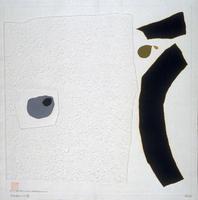
Poem-Z
Maki Haku
Delightful Rain
Se-Ok Suh
Dibujo Concreto 11k
Raul Lozza
Random Movement Fields (V 72-78 S)
Herman de Vries
Weisse Struktur (Spiegelung)
Gerhard von Graevenitz
Orange and Lavender No. 72
Adolph Gottlieb
Poem - A (心)
Maki Haku
Inner Space
Luciano Bartolini
Rules of Inference
Mel Bochner
Ponctuation
Pol Bury
Tablecloth XII
Pavlo Makov
Superficie lunare
Giulio Turcato
Abstract Composition
Bart van der Leck
Forme Madi
Carmelo Arden Quin