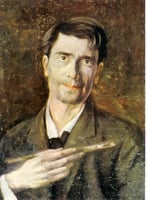
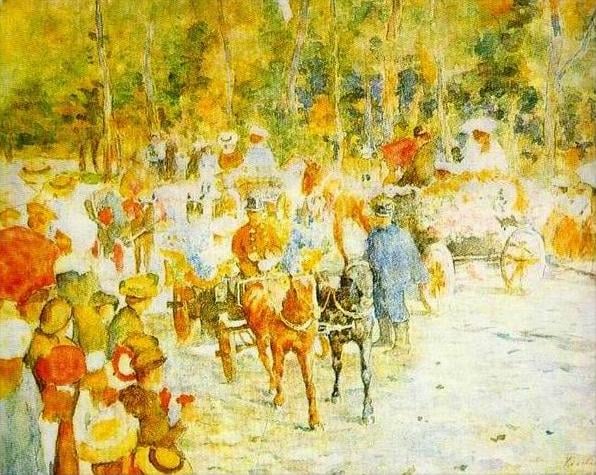
Flower Fight on the Road
Expert analysis of Stefan Luchian’s Flower Fight on the Road
Style: Impressionism · Genre: genre painting
Expert Analysis: Flower Fight on the Road by Ștefan Luchian
Ștefan Luchian’s Flower Fight on the Road stands as a vibrant testament to the artist’s pivotal role in adapting French Impressionism to a distinctly Romanian sensibility. Executed in the late 19th or early 20th century, this genre painting captures a spontaneous moment of rural play—children or peasants pelting each other with blossoms along a sun-dappled country lane. The work’s significance lies in how Luchian marries the Impressionist preoccupation with light, color, and fleeting sensation with the earthy, anecdotal charm of everyday life in the Romanian countryside.
Impressionist Technique: Luchian employs the hallmark broken brushwork and pure, unblended pigments typical of Impressionism. The road itself becomes a shimmering ribbon of ochre, violet, and pale green, reflecting the shifting sunlight filtering through overhanging leaves. The flying flowers are rendered as quick dabs of crimson, white, and pink—their trajectories suggested rather than outlined, evoking the instantaneous, chaotic joy of the battle. Luchian’s palette is notably high-key, with cool shadows (blues and lavenders) contrasting against warm highlights, a clear debt to Monet and Sisley.
Genre Significance: As a genre painting, Flower Fight elevates a trivial, rustic pastime into a subject worthy of serious artistic attention. In the context of Romanian art at the turn of the century, Luchian broke from academic, historical, or nationalist allegories to focus on spontaneous human interaction. The scene is unposed, almost snapshot-like—figures are partially cropped, their faces obscured in movement, emphasizing the fleeting, unidealized nature of the moment. This aligns with the Impressionist goal of capturing “modern life” but infuses it with a folkloric, pastoral warmth unique to Luchian’s cultural milieu.
Art Historical Importance: Luchian is often called the father of modern Romanian painting, and Flower Fight on the Road exemplifies why. While deeply rooted in Parisian Impressionism—especially in its dissolution of form into light and color—Luchian’s work resists the urban alienation of his French counterparts. Instead, his brush brings a tactile, sunlit vitality to rural Romania, transforming a local flower fight into a universal celebration of spontaneity. The painting thus serves as a bridge: it assimilates a Western avant-garde style while asserting the beauty of vernacular life, ensuring Luchian’s legacy as a national artist who expanded Impressionism’s emotional and geographic range.
In sum, Flower Fight on the Road is not merely a charming scene—it is a radiant synthesis of technique, place, and feeling, marking Ștefan Luchian as a master who made Impressionism speak in a Romanian accent.
Visually similar
20 works with related composition and palette
The Bridle Path, Central Park
Maurice Prendergast
Central Park
Maurice Prendergast
Central Park
Maurice Prendergast
Evening on Holy Saturday
Vasily Perov
A Country Wedding
George Hemming Mason
A Country Wedding
George Hemming Mason
Afternoon, Pincian Hill
Maurice Prendergast
City Scene
William James Glackens
Flower seller
Pablo Picasso
Beach Scene
Eugene Boudin
Весілля в Україні
Микола Пимоненко
Central Park, New York
Maurice Prendergast
For the Grape Harvest (From the Life of the Gypsies)
Theophrastos Triantafyllidis
Horseback Riders
Maurice Prendergast
The Square of a provincial town
Konstantin Yuon
The Drive, Central Park
William James Glackens
Squanton (also known as Men in Park with a Wagon, Squanton)
Maurice Prendergast
Collectors
Robert Spencer
At the Park
Maurice Prendergast
The dump at the door of Asier
Giovanni Boldini