
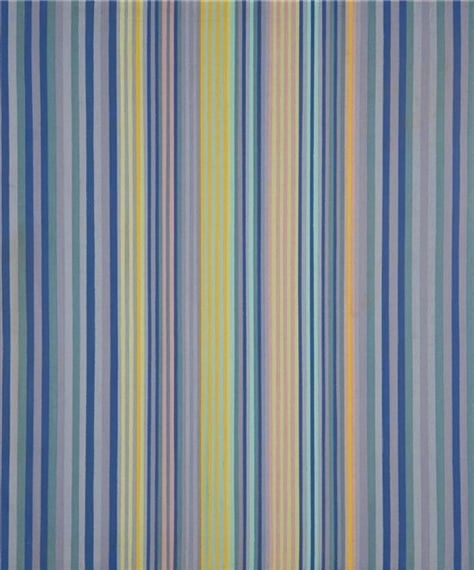
Analisi esperta di Midnight Watch di Gene Davis
Stile: Color Field Painting · Genere: abstract
Expert Analysis: "Midnight Watch" by Gene Davis
Gene Davis’s Midnight Watch stands as a quintessential example of Color Field painting, a movement that emerged in the 1950s and 1960s as a radical departure from Abstract Expressionism’s gestural intensity. Davis is celebrated for his signature series of rhythmic, vertical stripes, and this work encapsulates the movement’s core ambition: to make color itself the primary subject, liberated from narrative, symbolism, or spatial illusion.
Significance within the Style:
-
Color as Pure Sensation: In Midnight Watch, Davis presents a tightly packed field of narrow, repeated bands. Despite the title’s nocturnal connotation, the palette likely oscillates between deep, somber hues (blacks, indigos, or violets) and unexpected, luminous accents—a hallmark of Davis’s method. He believed that color should act directly on the retina, creating a “push-pull” effect that vibrates and pulses, drawing the viewer into an immersive, almost hypnotic experience. The lack of distinct forms or edges forces attention onto the relational qualities of the colors themselves.
-
Rejection of Compositional Hierarchy: True to Color Field principles, Davis eliminates traditional composition—there is no central focal point, no foreground/background distinction. The stripes run edge-to-edge, suggesting infinite extension beyond the canvas. This flatness aligns with Clement Greenberg’s idea of “optical space,” where the picture plane is acknowledged as a literal surface rather than a window into a depicted world.
-
Rhythm and Repetition: Unlike the all-over fields of a painter like Mark Rothko, Davis introduces a systematic, rhythmic structure. The varying widths and color intervals of the stripes create a staccato beat, a visual “music” that engages the eye in a temporal scanning motion. This repetitive yet subtly irregular pattern is what distinguishes Davis from other stripe painters (e.g., Kenneth Noland) and gives Midnight Watch its dynamic, lyrical quality.
Within the Abstract Genre:
Midnight Watch is not an exercise in pure geometry but a meditation on perception. The title suggests a quiet, watchful pause—perhaps the stillness of night—yet the stripes vibrate with energy, capturing the tension between stillness and movement. Davis’s work is significant because it demonstrates that abstract art can be simultaneously rigorous (in its systematic structure) and purely emotional (in its color relationships). He expanded the possibilities of abstraction by proving that a single, repeated motif—the stripe—could yield infinite expressive variation.
In summary, Midnight Watch is significant as a masterful realization of Color Field painting’s ideals: it presents color as an autonomous, sensory force, strips away all anecdotal content, and invites the viewer into a direct, contemplative dialogue with hue and rhythm. It stands as a testament to Gene Davis’s unique contribution to post-war American abstraction—an art that is at once radical, meditative, and profoundly optical.
Visivamente simili
20 opere con composizione e palette affini
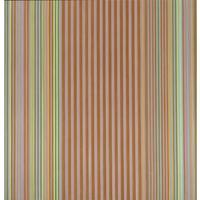
Cannonball
Gene Davis
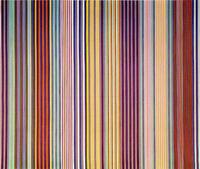
Royal Veil
Gene Davis

Red Baron
Gene Davis
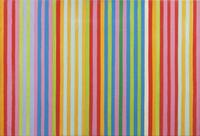
Red Chatterbox
Gene Davis
Jack-in-the-Box
Gene Davis
Untitled
Gene Davis

Gothic Jab
Gene Davis

Dr. Peppercorn
Gene Davis

Royal Canoe
Gene Davis
Zebra
Gene Davis
Limelight/Sounds of Grass
Gene Davis

Diamond Jim
Gene Davis
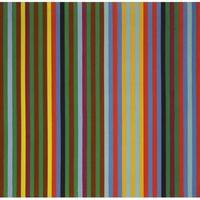
Circus Sounds
Gene Davis
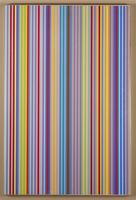
Battle for Grownups
Gene Davis
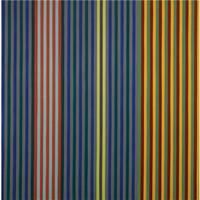
Split Beat
Gene Davis
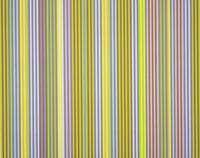
Black Popcorn
Gene Davis
Blue Broad Jump
Gene Davis
Solar Diary (Needle Park)
Gene Davis
Flower Machine
Gene Davis
Apricot Ripple
Gene Davis