John William Godward sanatçısının The Tambourine Girl eseri hakkında uzman analizi
Tarz: Neoclassicism · Tür: portrait
Expert Analysis: "The Tambourine Girl" by John William Godward
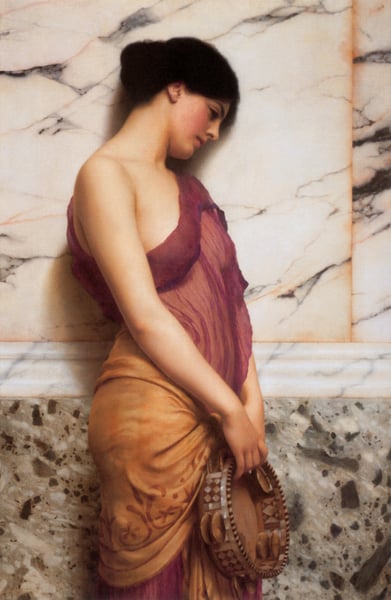
John William Godward’s The Tambourine Girl stands as a quintessential example of late Victorian Neoclassicism, a style that sought to revive the grace, order, and idealized beauty of ancient Greco-Roman art. Painted during the twilight of the 19th century, Godward’s work captures a moment of serene stillness that belies the energetic instrument the subject holds.
Significance within Neoclassicism:
Godward was a devoted practitioner of Neoclassical principles, yet he infused them with a distinctly Victorian sensibility. In this portrait, the subject is not a mythological goddess nor a historical heroine, but a nameless, timeless maid—a “type” rather than an individual. This approach aligns with Neoclassicism’s emphasis on universal harmony and idealized form, but Godward elevates it through his obsessive attention to material textures. The cool, flawless marble of the balustrade behind her, the soft sheen of her draped peplos, and the subtle translucency of her skin are rendered with almost photographic precision. This technical virtuosity, combined with a palette of warm marble whites, soft pinks, and muted gold, creates a palpable sense of luxury and calm.
The Role of the Tambourine:
The tambourine is a key symbol. In Neoclassical art, musical instruments often evoke the arts, leisure, and the pleasure of the senses—themes central to the Aesthetic movement that Godward admired. Yet her expression is thoughtful, even melancholy. This tension between the lively prop and the model’s introspective gaze is a hallmark of Godward’s best work: he presents a surface of serene perfection while hinting at an inner life. The tambourine also recalls the Bacchic revelry of ancient Rome, but the scene is sanitized and quieted for a Victorian audience, making the classical world feel safe, beautiful, and distant.
Genre as Portrait:
Though classified as a portrait, the work is less a record of a specific sitter and more a study in Neoclassical idealization. Godward frequently used the same professional models, but their identities are subsumed into a timeless vision. This merging of portraiture with idealized genre painting was a signature of his late career, allowing him to explore formal beauty without the constraints of strict historical narrative.
Historical Context and Rarity:
Godward painted during a period when Neoclassicism was increasingly seen as old-fashioned, overshadowed by Impressionism and Modernism. His unwavering commitment to this style—and his tragic suicide in 1922—has lent his oeuvre a poignant significance. The Tambourine Girl exemplifies the technical perfection and emotional restraint that define his legacy: a world of eternal, unruffled classicism, painted with a devotion that borders on the obsessional. In this piece, the viewer is invited not into a story, but into a moment of arrested beauty—a hallmark of Godward’s unique contribution to Neoclassical portraiture.
Museum / Gallery
Tür
Stil
Görsel olarak benzer
İlişkili kompozisyon ve renk paletine sahip 20 eser

Drusilla
John William Godward

Pompeian Girl
John William Godward
The Tambourine Player
John William Godward
Ismenia
John William Godward
A Grecian Girl
John William Godward

An Offering to Venus
John William Godward
Grecian Idyll
John William Godward
At the Fountain
Frederic Leighton

Sweet Dreams
John William Godward

At the Thermae
John William Godward

Contemplation
John William Godward

Girl with a Mirror
John William Godward

Absence Makes the Heart Grow Fonder
John William Godward

A Congenial Task
John William Godward
A Classical Lady
John William Godward
Reverie
John William Godward

Ionian Dancing Girl
John William Godward

Autumn
John William Godward

Sabinella
John William Godward
A Roman Matron
John William Godward