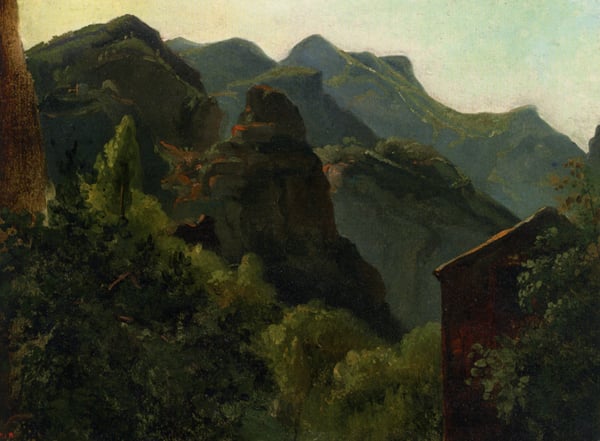
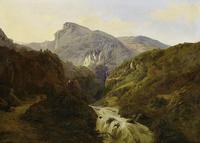
Side of the Valley of Saint-Vincent (Auvergne)
Dettagli
Analisi esperta di Side of the Valley of Saint-Vincent (Auvergne) di Theodore Rousseau
Stile: Realism · Genere: landscape
Expert Analysis: "Side of the Valley of Saint-Vincent (Auvergne)" by Théodore Rousseau
As a cornerstone of the Barbizon School and a direct forerunner of French Realism, Théodore Rousseau’s Side of the Valley of Saint-Vincent (Auvergne) exemplifies the radical shift from idealized, Neoclassical landscapes to a truthful, observational depiction of nature. Painted in the mid-19th century, this work captures a rugged, unglamorized view of the Auvergne region—a volcanic landscape in central France that Rousseau frequently visited for its dramatic geological forms and raw light.
Significance within Realism and Landscape Tradition
Rousseau rejected the studio-based conventions of his era, which demanded that landscapes be composed according to classical formulas (e.g., Claude Lorrain’s balanced arcadian scenes). Instead, he worked en plein air, immersing himself in the specific topography and atmospheric conditions of the site. This painting’s significance lies in its unflinching attention to the ordinary, even harsh, aspects of rural terrain: the steep, rocky slope, the sparse vegetation, and the overcast sky that filters light unevenly across the valley. Every tree trunk, stone, and patch of grass is rendered with a dense, tactile brushwork that emphasizes texture over idealization.
The composition is deliberately asymmetrical and “unfinished” in the eyes of traditionalists—a hallmark of Rousseau’s commitment to authenticity. The valley does not recede into a distant, harmonious vista; rather, the viewer’s eye is drawn into a tangled foreground of roots and rubble, mirroring the untamed character of the Auvergne landscape. This approach directly anticipates the Realist credo: to depict the world as it is, without moral or aesthetic embellishment.
Moreover, the work is significant for its emotional resonance. Rousseau’s landscapes are often described as having a “mood” or “temperament”—here, the muted earth tones and heavy atmosphere convey a sense of solitude and the sublime indifference of nature. This psychological depth would later influence both the Impressionists (in their pursuit of transient light) and the Symbolists (in their search for inner truth).
In sum, Side of the Valley of Saint-Vincent (Auvergne) is a vital document of Realism’s break from the past, demonstrating how a landscape could be both scientifically observed and deeply felt. It stands as a testament to Rousseau’s belief that the most profound beauty is found not in ideal forms, but in the honest recording of the world’s rough, weathered face.
Visivamente simili
20 opere con composizione e palette affini
Paysage rocheux avec une rivière
Louis Gauffier
A View of the Monastery of San Cosimato, to the North of Rome
Jean-Joseph-Xavier Bidauld
Sketch for the Chapel of the Virgin at Subiaco
Samuel Morse
Mountains of Arco at Riva
Ferdinand Georg Waldmüller
Landscape
Gabriele Smargiassi
Valley in the Auvergne Mountains
Theodore Rousseau
Bjerglandskab Med En Flod
Claude-Joseph Vernet
The Cloister of San Cosimato
Joseph Wright
View of the Puy de Dôme and Royat
Theodore Rousseau
Valley gorge With dairymaid
Carl Spitzweg
The Bard
John Martin
Scene from 'The Last of the Mohicans', by James Fenimore Cooper
Thomas Cole
Scene from The Last of the Mohicans Cora Kneeling at the Feet of Tanemund
Thomas Cole
Travellers in the mountains
Carlo Ademollo
View of Tiflis
Lev Lagorio
Darial Gorge
Ivan Aivazovsky
iew of the Königssee
Adolf Chwala
In the White Mountains
David Johnson
Withewater in the Albanian mountains near Rome
Edouard de Vigne
Passing by on the Other Side
Alexandre-Gabriel Decamps