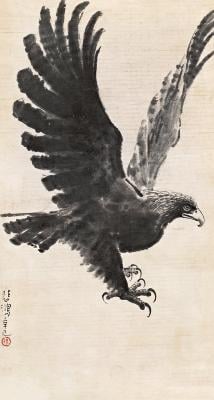
Analisi esperta di An Eagle di Xu Beihong
Stile: Expressionism, Ink and wash painting · Genere: animal painting
Expert Analysis: "An Eagle" by Xu Beihong
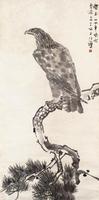
Xu Beihong’s “An Eagle” stands as a remarkable fusion of two seemingly divergent traditions: the millennia-old Chinese ink-wash technique and the emotive, gestural energy of Expressionism. Within the context of early 20th-century Chinese art, this work is significant for its bold synthesis of Eastern and Western sensibilities—a hallmark of Xu’s pioneering role in modernizing Chinese painting.
Stylistic Innovation: Ink Wash Meets Expressionist Energy
The painting employs the classic Chinese medium of ink on paper, with its swift, calligraphic strokes and subtle gradations of tone. Yet Xu infuses these traditional brushworks with a distinctly Expressionist intensity. The eagle’s fierce gaze, the sharp, angular contours of its beak, and the dynamic, almost explosive rendering of its feathers convey a raw emotional power that transcends the decorative or allegorical conventions of earlier Chinese animal painting. Instead of a serene, symbol-laden image, Xu presents a creature caught in a moment of vigilant tension—its body poised for action, its vitality palpable.
Genre as Moral Metaphor
The eagle, in Chinese culture, often symbolizes strength, courage, and solitary nobility. Xu Beihong, living through periods of national upheaval and war, frequently used animal subjects to channel patriotic and moral ideals. In “An Eagle,” the bird’s proud, unflinching posture can be read as a metaphor for resilience and independence—qualities Xu admired and promoted in his reform of Chinese art and society. This elevates the work beyond mere naturalistic study into a statement of character and spirit.
Significance Within Xu’s Oeuvre and His Era
Xu Beihong is best known for his realistic horse paintings, but his eagles and other birds of prey demonstrate a more overtly Expressionist side. Here, he prioritizes emotional impact over anatomical precision—though his training in Western drawing is evident in the bird’s solid structure and foreshortened head. “An Eagle” thus exemplifies his belief that Chinese ink painting could absorb Western expressive techniques without losing its own lyrical identity. It is a testament to how Xu redefined the animal painting genre: not as a static emblem, but as a vehicle for modern, passionate expression that resonates with both Chinese literati tradition and global modernist currents.
Visivamente simili
20 opere con composizione e palette affini
Hawk
Xu Beihong
Eagle
Xu Beihong
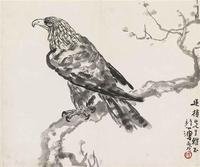
Hawk
Xu Beihong
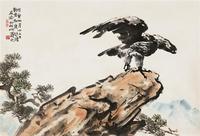
Eagle
Xu Beihong
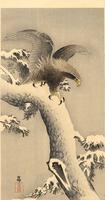
Eagle under snow
Ohara Koson
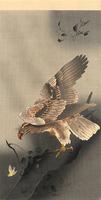
Swooping Eagle
Ohara Koson
Eagle
Xu Beihong
107. Fukagawa Susaki and Jūmantsubo
Hiroshige
Eagle and rabbit
Leon Bonnat
Hochwido
Owon
Canyon
Robert Rauschenberg
Otto of the Silver Hand 27
Howard Pyle
Eagle (from Sketchbook)
Thomas Sully
Crows Fly by Red Sky at Sunset
Shibata Zeshin
Eagle and Snake
William Hawkins
Eagle
Gazmend Freitag
Eagle in descent
Ohara Koson
Hawk
Utagawa Kuniyoshi
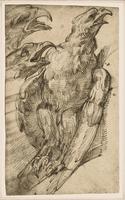
Study of An Eagle
Bartolomeo Passerotti
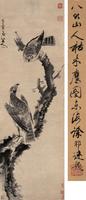
Eagles in Withered Tree
Bada Shanren