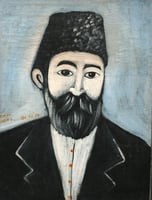
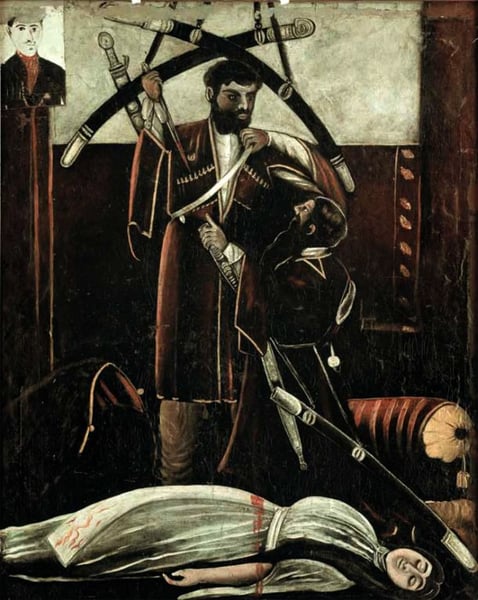
Expert analysis of Niko Pirosmani’s Sister and brother (according to the play by V. Gunia)
Style: Naïve Art (Primitivism) · Genre: genre painting
Expert Analysis: "Sister and brother (according to the play by V. Gunia)" by Niko Pirosmani
This painting is a quintessential example of Naïve Art (Primitivism), a style defined by its rejection of academic conventions in favor of intuitive, direct expression. Niko Pirosmani, a self-taught Georgian artist of the late 19th and early 20th centuries, is celebrated for his ability to distill complex human narratives into stark, emotionally resonant compositions.
Significance within Naïve Art:
Pirosmani’s work stands apart for its deliberate flatness, bold outlines, and vivid, unmodulated colors—hallmarks of the naïve aesthetic. Unlike many Western primitivists who sought to imitate "primitive" forms, Pirosmani’s vision was deeply rooted in his own cultural identity and everyday life in Tbilisi. In Sister and brother, he translates a dramatic scene from a play by Georgian playwright V. Gunia into a static, almost iconic tableau. The figures are frontal, simplistically drawn, and set against a shallow, non-naturalistic background, emphasizing emotional truth over spatial illusion.
Genre Painting as Cultural Mirror:
As a genre painting, the work depicts a moment from a specific theatrical source, yet Pirosmani elevates it beyond mere illustration. His characters—likely shown in a moment of familial tension or tenderness—are rendered with a universal gravity. The lack of perspective or detailed anatomy forces the viewer to focus on posture, gaze, and the austere relationship between the siblings. Pirosmani’s use of solid black backgrounds or stark white spaces (a frequent device) isolates the figures, amplifying their psychological weight.
Why This Work Matters:
Pirosmani’s art is significant because it bridges folk tradition and modernism. His naïve style, long dismissed as untrained, later influenced avant-garde movements (from the Blue Rider to Cubo-Futurism). Sister and brother exemplifies his mastery of telling profound stories through the simplest means—a quality that makes his oeuvre a cornerstone of global Naïve Art. The painting’s theatrical source also underscores Pirosmani’s engagement with contemporary Georgian culture, embedding his work in a lived, social context rather than a purely decorative one. In its raw sincerity, it challenges hierarchies of artistic skill, proving that emotional resonance can transcend technical polish.
Museum / Gallery
Visually similar
20 works with related composition and palette
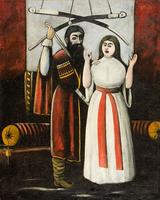
Sister and brother (according to the play by V. Gunia)
Niko Pirosmani
Portrait of a wealthy peasant
Niko Pirosmani
Self-portrait in a Suit of a Caucasian Warrior
Alexander Orlowski
Man with a horn for drinking wine (Portrait of Meliton Chkheidze)
Niko Pirosmani
Caucasian prince
Ivan Tvorozhnikov
Leila and Khaji-Abrek
Nikolai Ge
Sketch for "Surami Fortress"
Petre Otskheli
Two Georgians by a Giant Wine Jar (Quevri)
Niko Pirosmani
Giorgi Saakadze defending Georgia from enemies
Niko Pirosmani
The feast of Kupreishvili family
Niko Pirosmani
The feast of three Nobles in the valley
Niko Pirosmani
Shamili with a bodyguard
Niko Pirosmani
Makar Simak (Plastun)
Ilya Repin
General in the form of royal guards. P.A. Cherevin.
Ilya Repin
The feast in a grape gazebo
Niko Pirosmani
Armenian dance
Martiros Sarian
Shepherd in a felt cloak on a red background
Niko Pirosmani
The feast of Tbilisian merchants accompanied by the gramophone
Niko Pirosmani
Farewell of Zara with Ismail
Mikhail Vrubel
Lezginka
Vasily Vereshchagin