Analisi esperta di Giorgi Saakadze defending Georgia from enemies di Niko Pirosmani
Stile: Naïve Art (Primitivism) · Genere: battle painting
Expert Analysis: Giorgi Saakadze Defending Georgia from Enemies by Niko Pirosmani
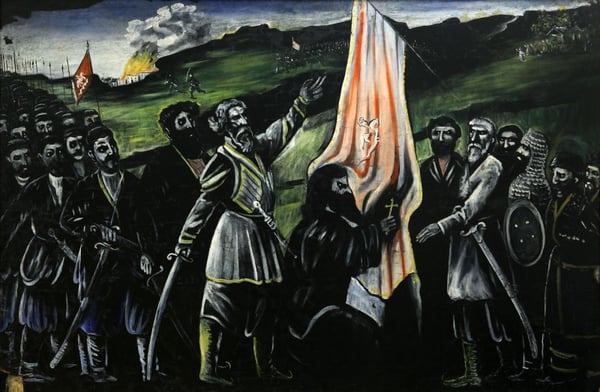
Niko Pirosmani’s Giorgi Saakadze Defending Georgia from Enemies exemplifies the transformative power of Naïve Art (Primitivism) when applied to the traditionally grand, academic genre of battle painting. As a self-taught Georgian artist, Pirosmani brings a radically simplified, direct vision to this historical subject—the 17th-century military commander Giorgi Saakadze, a national hero. The work’s significance lies in how its primitive style both honors and subverts the conventions of battle art.
Unlike the dramatic chiaroscuro, complex foreshortening, and chaotic movement of academic battle paintings (e.g., by Delacroix or Rubens), Pirosmani’s composition is starkly flat, with figures arranged in a frieze-like procession against a monochrome or minimally detailed background. Colors are pure, unmodulated, and applied in broad planes—deep blacks, earthy browns, and stark whites—giving the scene a folk-art immediacy. The horses and soldiers are frontal and static, their bodies rendered with a charming, almost childlike geometry; there is no illusion of deep space or anatomical precision. This lack of naturalism, however, is not a deficiency but a deliberate aesthetic choice that channels the spirit of Georgian folk iconography and religious mural traditions.
Within the context of Primitivism, this painting is significant for its cultural specificity. While European primitivists (e.g., Henri Rousseau) often escaped into exotic or imaginary jungles, Pirosmani grounds his Naïveté in Georgian history and nationalism. Giorgi Saakadze functions as a heroic icon: the commander’s enlarged scale relative to his enemies, his calm, frontal posture, and the stark contrast between his dark horse and the lighter background elevate him to a symbolic, almost mythic status. The violence of battle is rendered with decorous restraint—no gore, no turbulent diagonals—replaced by a solemn, processional dignity.
Moreover, Pirosmani’s work achieved recognition in the early 20th century, influencing the Georgian avant-garde and later the European fascination with “naïve” art. In this piece, the primitive style does not diminish the subject’s power; rather, it strips away academic artifice to reveal a purer emotional core—patriotic devotion expressed through the unpretentious language of folk memory. The painting stands as a testament to how Naïve Art can reclaim national history from elite culture, making it accessible, iconic, and profoundly human.
Museum / Gallery
Visivamente simili
20 opere con composizione e palette affini
Sister and brother (according to the play by V. Gunia)
Niko Pirosmani
Shamili with a bodyguard
Niko Pirosmani
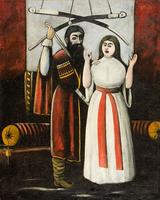
Sister and brother (according to the play by V. Gunia)
Niko Pirosmani
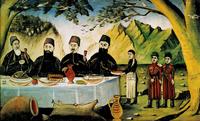
The feast of Gvimradze family
Niko Pirosmani
Jumping over Bonfire
Azim Azimzade
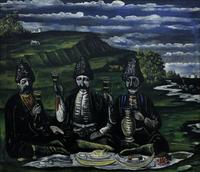
The feast of three Nobles in the valley
Niko Pirosmani
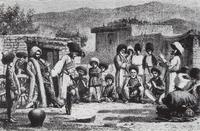
Lezginka
Vasily Vereshchagin
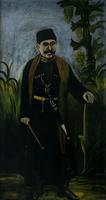
Portrait of a wealthy peasant
Niko Pirosmani
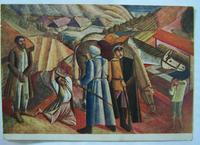
Shooting
Vasyl Sedlyar
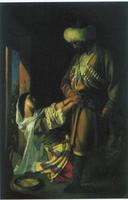
Leila and Khaji-Abrek
Nikolai Ge
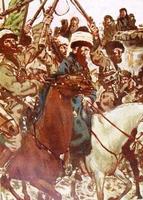
Illustration to Leo Tolstoy's «Hadji-Murat»
Eugene Lanceray
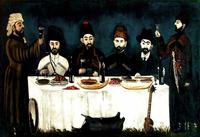
The feast of Kupreishvili family
Niko Pirosmani
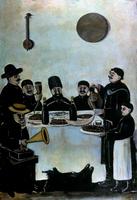
The feast of Tbilisian merchants accompanied by the gramophone
Niko Pirosmani
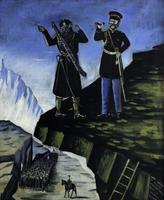
Shete showing the way to Noble Baryatinski in order to arrest Shamili
Niko Pirosmani
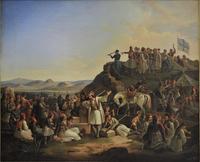
The camp of Karaiskakis
Theodoros Vryzakis
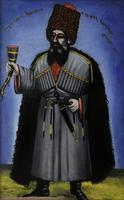
Man with a horn for drinking wine (Portrait of Meliton Chkheidze)
Niko Pirosmani
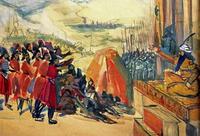
Design for opera by A. Spendiarov 'Almast'
Martiros Sarian
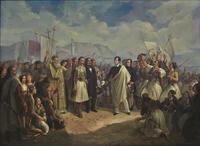
Lord Byron's reception at Messolonghi
Theodoros Vryzakis
Battle of Rocroi, during the Thirty Years' War
Jean Victor Schnetz
Two Georgians by a Giant Wine Jar (Quevri)
Niko Pirosmani