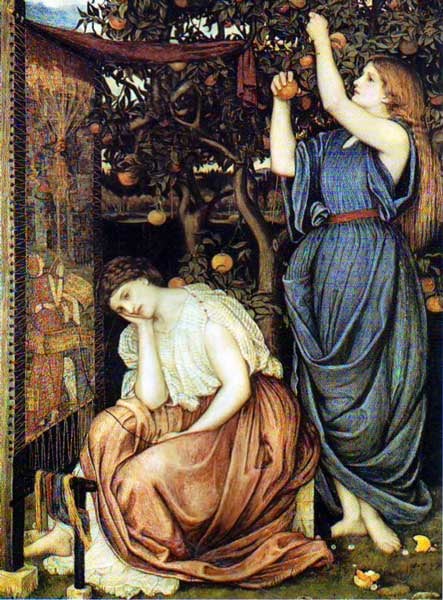
John Roddam Spencer Stanhope sanatçısının Penelope eseri hakkında uzman analizi
Tarz: Romanticism · Tür: literary painting
Expert Analysis of "Penelope" by John Roddam Spencer Stanhope
Style & Period Context (Romanticism)
As a work of Romanticism, "Penelope" embodies the movement’s emphasis on intense emotion, individual experience, and a fascination with the distant past—particularly classical antiquity and medieval legend. Romantic painters often sought to evoke powerful feelings through dramatic composition, rich color, and symbolic detail. Stanhope’s choice of Penelope, the faithful wife of Odysseus from Homer’s Odyssey, aligns perfectly with Romanticism’s preference for literary and mythological subjects that explore timeless human virtues and struggles. The painting presents Penelope not merely as a historical figure but as an emblem of patience, loyalty, and resilience—qualities that resonated deeply with Romantic ideals of noble endurance against adversity.
Genre Significance (Literary Painting)
Within the genre of literary painting, "Penelope" draws directly from a canonical text, making it a visual translation of Homer’s epic. This genre was prized in the 19th century for elevating narrative art to the level of poetry, and Stanhope’s work stands out for its ability to condense a complex story into a single, poignant moment. Typically, Penelope is shown at her loom, weaving by day and unraveling by night to delay her suitors. Stanhope likely emphasizes this act of craft as both a literal and metaphorical expression of her fidelity—a quiet, heroic resistance. The painting’s significance lies in its fusion of Romantic emotional intensity with literary fidelity, capturing the psychological weight of waiting and hope.
What Makes It Significant
"Penelope" is significant for its contribution to the Romantic revival of classical themes, bridging the gap between academic history painting and the more intimate, expressive concerns of Romanticism. Stanhope’s treatment exemplifies how Romantic artists reimagined ancient stories to reflect contemporary values: Penelope becomes a model of Victorian domestic virtue and stoic femininity, while still retaining her mythic grandeur. The work also demonstrates Romanticism’s interest in the interior life—her steady gaze and solitary labor invite the viewer to contemplate her inner world of memory, longing, and resolve. In this way, the painting transcends mere illustration, offering a psychological portrait that is both timeless and distinctly Romantic.
Görsel olarak benzer
İlişkili kompozisyon ve renk paletine sahip 20 eser
Love and the Maiden
John Roddam Spencer Stanhope
Cupid Finding Psyche
Edward Burne-Jones
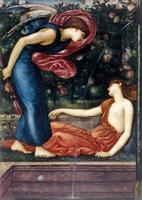
Cupid finding Psyche: winged cupid standing over body of Psyche asleep below a fountain, roses on a trellis behind
Edward Burne-Jones
The Spring
Sandro Botticelli
The Three Graces from Primavera
Sandro Botticelli
The Garden of the Hesperides
Edward Burne-Jones
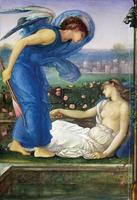
Cupid and Psyche
Edward Burne-Jones
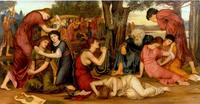
By the Waters of Babylon
Evelyn De Morgan
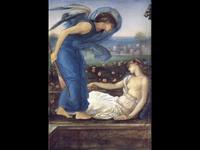
Finding Psyche
Edward Burne-Jones
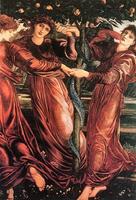
The Garden Of The Hesperides
Edward Burne-Jones
Earth Mother
Edward Burne-Jones
A Masque for the Four Seasons
Walter Crane
Fall of Man
Lucas Cranach the Elder
Mythological Scene
Dosso Dossi
Harmony or The Three Graces
Hans Baldung
Death and the Maidens
Pierre Puvis de Chavannes
Laus Veneris
Edward Burne-Jones
Hymn to spring
Arnold Böcklin
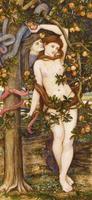
The Temptation of Eve
John Roddam Spencer Stanhope
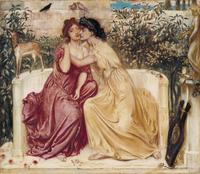
Sappho and Erinna in a Garden at Mytilene
Simeon Solomon