
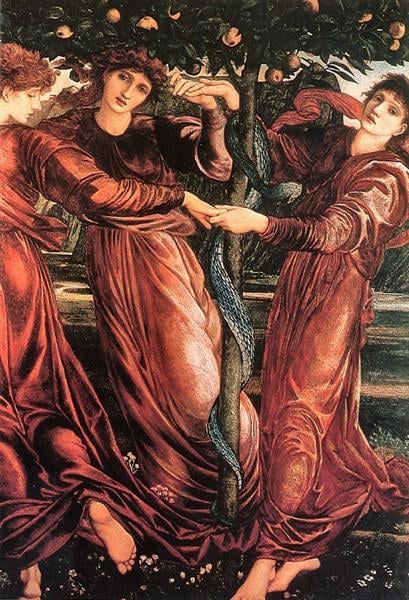
The Garden Of The Hesperides
Details
Expert analysis of Edward Burne-Jones’s The Garden Of The Hesperides
Style: Romanticism · Genre: mythological painting
Expert Art Historical Analysis: The Garden of the Hesperides by Edward Burne-Jones
In The Garden of the Hesperides, Edward Burne-Jones presents a mythological painting firmly rooted in the Romantic sensibility. Within the Romantic style, such works often turn to classical myth not for historical accuracy, but as a vehicle for emotional intensity, idealized beauty, and a yearning for a lost, enchanted past. Burne-Jones, a leading figure of the later Pre-Raphaelite circle and a forerunner of Symbolism, here achieves a synthesis of Romantic yearning with a meticulous, decorative precision that transcends mere illustration.
The significance of this artwork lies in its embodiment of Romanticism’s fascination with the unattainable and the otherworldly. The Hesperides—nymphs who guard the golden apples of immortality in a sacred garden—are rendered as languid, ethereal figures caught in a timeless, dreamlike stasis. This is characteristic of Burne-Jones’s mature style: the figures are weightless, the composition flattened into a tapestry-like arrangement, and the atmosphere suffused with a quiet, melancholic tension. Unlike the dynamic heroics of earlier Romantic painters (e.g., Delacroix), Burne-Jones’s Romanticism is introspective, evoking a world of serene melancholy and psychological depth.
The painting is also significant for its role in bridging Romanticism’s love of myth with the emerging Aesthetic movement’s emphasis on “art for art’s sake.” The garden itself becomes a symbol of perfect yet inaccessible beauty—a core Romantic trope. The careful, almost medieval linearity and the rich, jewel-like colors (typical of Burne-Jones) elevate the scene from a mere mythological narrative to a meditation on desire, transience, and the power of the imagination. In The Garden of the Hesperides, the Romantic ideal finds its purest, most contemplative form: a vision of paradise that is as haunting as it is beautiful.
Museum / Gallery
Visually similar
20 works with related composition and palette
The Garden of the Hesperides
Edward Burne-Jones
Apollo and Daphne
Antonio del Pollaiolo
Love and the Maiden
John Roddam Spencer Stanhope
Apollo and Daphne
Piero del Pollaiolo
The return of Judith to Bethulia
Sandro Botticelli
The Temptation of Eve
John Roddam Spencer Stanhope
The Spring
Sandro Botticelli
Mythological Scene
Dosso Dossi
Poème de l'âme 13: Rayons de soleil
Louis Janmot
Vertumnus and Pomona
Francesco Melzi
Tobias and Archangel Raphael
Filippino Lippi
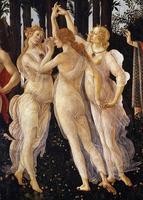
The Three Graces from Primavera
Sandro Botticelli
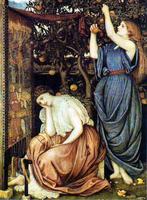
Penelope
John Roddam Spencer Stanhope
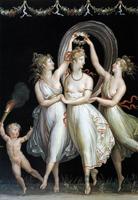
The Three Graces Dancing
Antonio Canova
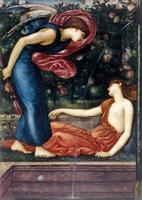
Cupid finding Psyche: winged cupid standing over body of Psyche asleep below a fountain, roses on a trellis behind
Edward Burne-Jones
A Masque for the Four Seasons
Walter Crane

The Four Seasons, Spring
Paul Cezanne
Cupid and Psyche
Edward Burne-Jones
Fall of Man
Lucas Cranach the Elder
Spona de Libano (The Bride of Lebanon)
Edward Burne-Jones