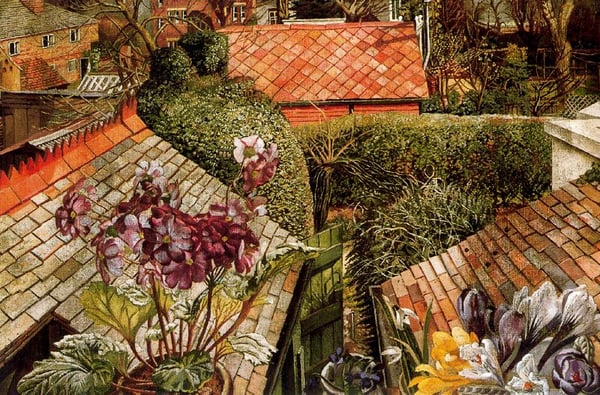
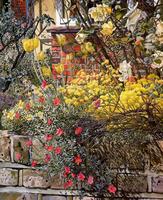
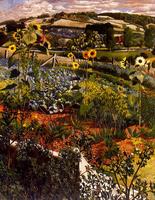
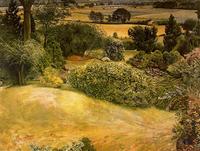
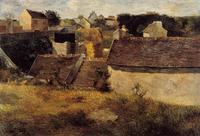
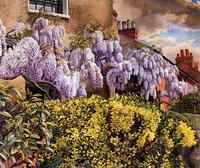
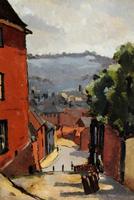
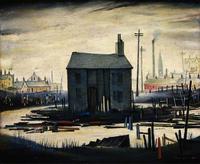
Stanley Spencer’s Flowers in a Window (Cookham) stands as a quintessential example of British Neo-Romanticism, a movement that sought to re-enchant the landscape through a deeply personal, visionary lens. Painted in his beloved home village, the work merges the domestic interior (the window and flowers) with the surrounding countryside of Cookham. This fusion of still life and landscape is central to Spencer’s significance within the period: he elevates an ordinary, humble scene into a site of spiritual and emotional resonance. The flowers, poised at the threshold between inside and outside, become both a celebration of natural beauty and a symbol of the continuity between human habitation and the pastoral world. In the context of Neo-Romanticism—a style that reacted against industrialization and urban modernity by reasserting a mystical connection to place—Spencer’s painting anchors that impulse in a specific, local geography. His meticulous, almost pre-Raphaelite attention to detail, combined with a visionary intensity, transforms a simple window view into a meditation on belonging, memory, and the sacred within the everyday.