
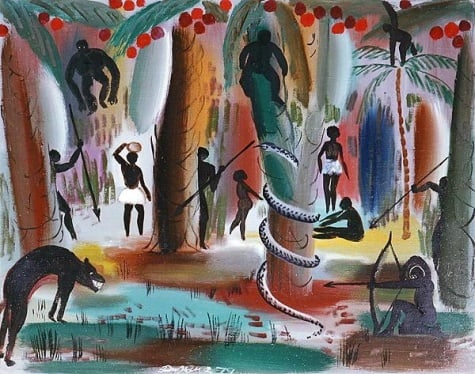
Analisi esperta di Jungle di Radi Nedelchev
Stile: Naïve Art (Primitivism) · Genere: symbolic painting
Artwork: Jungle
Artist: Radi Nedelchev (1938–2018)
Style: Naïve Art (Primitivism)
Genre: Symbolic painting
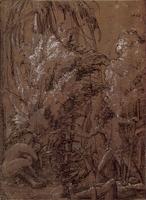
As an art historian examining Jungle within the framework of Naïve Art and Primitivism, what stands out immediately is the work’s defiant rejection of academic naturalism in favor of a raw, intuitive vision. Naïve art—often created by self-taught artists—prizes emotional directness, flattened perspective, and a childlike sincerity. Radi Nedelchev, a Bulgarian naïve painter, brings these qualities to full flower in Jungle, while infusing the scene with symbolic weight that elevates it beyond mere folkloric decoration.
The painting’s significance lies in how it marries the formal simplicity of Primitivism with a dense symbolic language. In typical naïve style, Nedelchev likely employs bright, unmixed colors, a simplified composition without atmospheric perspective, and a frontal, decorative arrangement of flora and fauna. But the title Jungle is not merely a landscape—it is a symbolic ecosystem, a microcosm of life’s vitality and hidden meanings. The jungle, in primitive and naïve traditions, often represents the untamed, the subconscious, or the cycle of growth and decay. Nedelchev’s treatment transforms the tropical vegetation into a vibrant tableau of archetypes: perhaps predatory animals, lush fruits, or human figures intertwined with nature, each element carrying allegorical resonance.
What makes Jungle significant within its style is the way it bridges folk art and modernism. While European Primitivism (think Henri Rousseau) often exoticized the “other,” Nedelchev’s work emerges from a genuine cultural wellspring—Bulgarian folk traditions, rich in symbolism and flat, patterned aesthetics. He does not mimic outsider art for effect; he embodies it. The painting’s symbolic genre allows it to function as a visual fable, where every leaf, beast, or flower is a node in a larger narrative about harmony, danger, or fertility.
Moreover, Nedelchev’s Jungle challenges the hierarchy of art history. It asserts that profound symbolic meaning does not require academic training. The work’s power comes from its unmanipulated authenticity: the untutored hand creates a world that feels both ancient and timeless, credible yet dreamlike. In the context of Naïve Art’s peak during the 20th century, this painting stands as a testament to the movement’s ability to offer an alternative modernism—one rooted in instinct, community memory, and unmediated emotion, rather than intellectual theory.
Ultimately, Jungle is significant because it proves that naïve symbolism can achieve the same complexity as high art, while retaining a freshness that formal painting often loses. Nedelchev invites us into a forest of signs, where we are free to wander without a guidebook, guided only by the artist’s unpretentious, heartfelt vision.
Visivamente simili
20 opere con composizione e palette affini
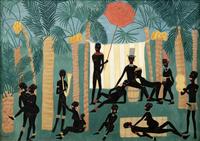
The Paradise of the Blacks
Toyen
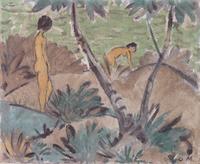
Zwei Mädchen Mit Gegabeltem Baum
Otto Mueller
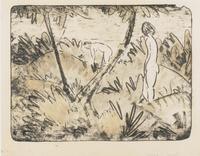
Zwei Mädchen Mit Gegabeltem Baum
Otto Mueller
The Hunt
Irma Stern
Killing of the Banquet Roast
Max Pechstein
Badende Am Waldsee
Otto Mueller
Slash and Burn
Leon Underwood
Tsamikos dance on the shore
Yiannis Tsaroychis
Mural
Arman Manookian
Blackamoor's Chamber. Fragment. Set Design
Alexandre Benois
Occupy Utopia
Alaa Awad
Fünf Badende in Seenlandschaft
Otto Mueller
Am Ufer (At the Riverbank)
Max Pechstein
Índias
Candido Portinari
Tree Female Nudes in the Pond
Otto Mueller
Apres La Pluie. Tarang, Yap
Paul Jacoulet
Africans in the autumn, the long yellow grass
Walter Battiss
Le Judgment de Paris
André Lhote
Landschaft Mit Badenden
Otto Mueller
Wild folk family
Albrecht Altdorfer