
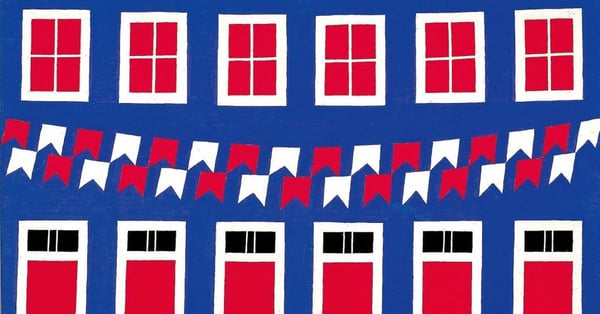
Expert analysis of Alfredo Volpi’s Grande fachada festiva
Style: Naïve Art (Primitivism) · Genre: cityscape
Expert Analysis of "Grande fachada festiva" by Alfredo Volpi
Alfredo Volpi’s “Grande fachada festiva” (Large Festive Façade) is a standout example of the artist’s mature Naïve Art (Primitivism) style, reimagining the cityscape genre through a distinctly Brazilian modernist lens. The work achieves significance by fusing the childlike directness of naïve painting with a sophisticated, geometric sense of order—a hallmark of Volpi’s contribution to 20th-century Latin American art.
Key Features and Significance:
-
Naïve Simplicity and Symbolic Color: The scene is reduced to essentials: a single, frontal façade of a festive building, likely inspired by the colonial architecture of Volpi’s native São Paulo or the fishing villages of the Brazilian coast. The “naïve” quality is evident in its flattened perspective, outlined forms, and unmodulated, vivid colors. Volpi uses a near-heraldic palette of deep blues, warm reds, and pure whites, with decorative bands that suggest celebration—bunting, flags, or festoons—rendered as rhythmic, almost abstract patterns. This simplification is not laziness but a deliberate return to a primal, visually honest mode of seeing.
-
Genre Transformed: As a cityscape, the painting deviates from realistic views. Instead of illustrating a broad street or plaza, Volpi zooms in on the façade itself, making the building a self-contained world. The “festive” title cues the viewer to read the symmetrical, flag-like elements as joyfully decorative, turning an everyday structure into a ceremonial icon. This approach aligns with Naïve Art’s tendency to treat all subjects with equal, reverential simplicity—whether a storefront, a church, or a festival house.
-
Significance within Style/Period: Volpi’s work is critical in the history of Brazilian art because it bridges European-inspired Primitivism (seen in artists like Rousseau) with local vernacular traditions. In the 1950s–60s, when Brazilian modernists were synthesizing folk art with avant-garde abstraction, Volpi’s “Grande fachada festiva” exemplifies his unique balance: the painting is both a naïve celebration of popular architecture and a proto-abstract composition of color fields and lines. Its flat, patterned surface anticipates his later, nearly pure geometric abstractions (the famous bandeirinhas and fachadas series), making it a pivotal work that shows how Naïve Art can achieve formal sophistication without losing its spontaneous charm.
Conclusion: “Grande fachada festiva” is significant because it epitomizes Volpi’s ability to elevate the naïve cityscape into a refined, joyful statement of national identity. The work stands as a testament to Primitivism’s power to find deep meaning in humble, everyday façades—transforming them into icons of pure, unpretentious beauty.
Visually similar
20 works with related composition and palette
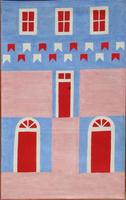
Fachada
Alfredo Volpi

Bandeirinhas
Alfredo Volpi
Kyiv Windows
Vudon Baklytsky
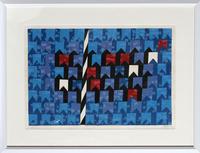
Bandeirinhas estruturadas
Alfredo Volpi
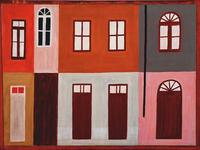
Casas
Alfredo Volpi
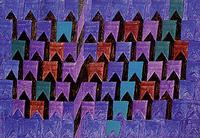
Bandeirinhas
Alfredo Volpi
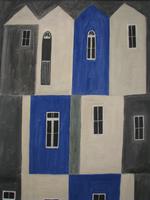
Casas
Alfredo Volpi
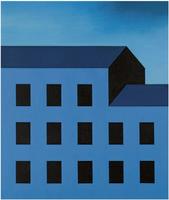
Painting
Roberto Aizenberg
Untitled
Alfredo Volpi
Festa de São João
Alfredo Volpi

Bandeirinhas
Alfredo Volpi

Tower
Roberto Aizenberg

Blue Bar
Jack Bush
Mastro de São Pedro
Alfredo Volpi

Bandeirinhas e Mastro
Alfredo Volpi

Stapel
Alfio Giuffrida

Composition sur fond bleu
Yves Laloy

CD Homes
Alfio Giuffrida

Red and Green with Pale Colors
Robert Goodnough
Neil House Columbus Landmark
William Hawkins