Analisi esperta di Gadular di Ivan Milev
Stile: Art Nouveau (Modern), Symbolism · Genere: genre painting
Expert Analysis of "Gadular" by Ivan Milev
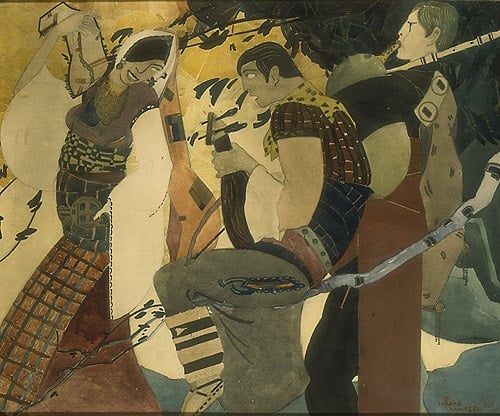
Ivan Milev’s Gadular (c. 1920s) is a landmark work within both Bulgarian modernism and the broader currents of Art Nouveau and Symbolism. The title refers to a folk musician playing the gadulka (a traditional bowed string instrument), immediately grounding the painting in national identity. Yet Milev elevates this genre scene through a radical synthesis of local folklore and pan-European stylistic innovation.
Significance within Style and Period:
-
Fusion of Art Nouveau and Symbolism: Milev’s treatment of line and ornament is recognizably Art Nouveau—sweeping, decorative contours, sinuous curves in the figure’s silhouette and the surrounding foliage. But the work’s introspective, almost mystical mood is pure Symbolism. The musician’s downward gaze and the interplay of muted, earthy tones (ochres, deep greens, and gold) suggest a transcendent moment, as if the music bridges the material and spiritual worlds. This dual allegiance places Gadular at the crossroads of European decorative elegance and Slavic symbolic depth.
-
Bulgarian National Modernism: At a time when many Eastern European artists sought to modernize by imitating Western models, Milev uniquely adapted Art Nouveau’s organic forms to Bulgarian folk motifs. The stylized floral patterns in the background recall traditional embroidery and woodcarving, while the figure’s costume is rendered with ethnographic precision. Gadular thus becomes a manifesto for a national modernism—one that reinterprets local heritage through avant-garde lenses, making it significant as a template for later Balkan art.
-
Genre Painting as Cultural Icon: Though a genre scene, Gadular transcends anecdote. The musician is not just a peasant performer but a symbolic guardian of tradition in an age of rapid modernization. The painting’s flattened space, rhythmic repetition of shapes, and muted palette evoke a timeless, ritualistic atmosphere—turning a simple folk musician into an emblem of spiritual resilience.
In sum, Gadular is significant because it demonstrates how Art Nouveau and Symbolism could be harnessed to forge a distinctly Bulgarian visual language, one that honors local roots while engaging with Europe’s most current artistic dialogues.
Genere
Visivamente simili
20 opere con composizione e palette affini
Otsu-e Paintings Coming Alive Triptych
Utagawa Kuniyoshi
A mean man will kill a woman with his sword
Katsushika Hokusai
The Ghosts of Togo and His Wife
Utagawa Kuniyoshi
A woman in shinto shrine has a stick with a lot of paper leaves
Katsushika Hokusai

Characters from the Kabuki Play Matsu Ha Misao Onna Kusunoki Niban-me
Tōshūsai Sharaku
Oguri Hangan Sukeshige in Battle
Utagawa Sadatora
Saitogo Kunitake, Japanese actor
Utagawa Kuniyoshi
Arashi Ryūzō and Morita Kan'ya VIII
Tōshūsai Sharaku
Shower
Kitagawa Utamaro
Nakajima Wadaemon I as Tanbaya Hachiemon
Tōshūsai Sharaku
Heroes of china and Japan
Utagawa Kuniyoshi
Street scenes newly pubished
Katsushika Hokusai
Shower
Kitagawa Utamaro
Hideyoshi and his wives
Kitagawa Utamaro
Kabuki Actors Matsumoto Kōshirō IV as Ninokuchimura Magoemon, and Nakayama Tomisaburō as Umegawa
Tōshūsai Sharaku
A man confronted with an apparition of the Fox goddess
Utagawa Kuniyoshi
Momiji gari
Tōshūsai Sharaku
Grab Tengu Nose
Tsukioka Yoshitoshi

The ghost of Taira Tomomori
Utagawa Kuniyoshi
Four seasons: Spring, Summer, Autumn, Winter
Utagawa Kunisada