
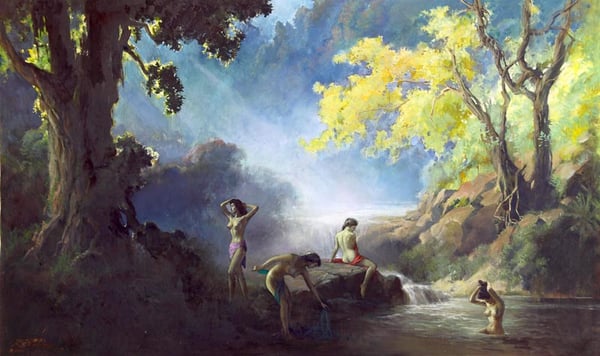
Bidadari Mandi
Expertenanalyse zu Basuki Abdullahs Bidadari Mandi
Stil: Realism · Genre: figurative
Expert Analysis: "Bidadari Mandi" by Basuki Abdullah
Basuki Abdullah’s “Bidadari Mandi” (Bathing Angels) stands as a masterful example of Southeast Asian Realism, seamlessly blending the technical precision of Western academic painting with indigenous subject matter and a distinctly Javanese sense of idealized beauty. Within the figurative genre, the work is significant for its refined naturalism, ethereal atmosphere, and cultural fusion that elevates a classical theme—the bathing nymph—into a symbol of local mythology and harmony with nature.
Realism as a vehicle for transcendence
Abdullah’s Realism is not merely documentary; it is poetic. Every detail—the soft translucency of water droplets on bare skin, the delicate play of light filtering through foliage, the sinuous contours of the female form—is rendered with a photographic fidelity that nonetheless feels dreamlike. This tension between observable reality and idealized grace is the hallmark of his technique. The artist studied in The Hague and was deeply influenced by the Dutch Romantic Realist tradition, yet he infuses his figures with the fluid, meditative elegance of Javanese dance and the classic wayang puppet aesthetic. The “bidadari” (heavenly nymphs) are not Western nudes but local spirits, their posture and gesture drawn from traditional courtly ideals of modesty and refinement.
Significance within the figurative tradition
In the context of mid-20th century Indonesian art, Abdullah was a pioneer who reconciled the colonial legacy of European academic painting with an emerging national identity. “Bidadari Mandi” belongs to a series of works that define his signature: the human body as a site of cultural negotiation. Unlike many Western Realists who pursued stark naturalism, Abdullah’s figures are soft, glossy, and emotionally serene—their skin tones warm, their forms pliant. The composition is carefully balanced: the central figure’s upward gaze and raised arms create a diagonal dynamism, while the surrounding water and vegetation frame her in a lush, protective cocoon.
What makes it significant
- Mastery of light and water: Abdullah’s ability to render subsurface scattering in the skin and the refractive clarity of water demonstrates a technical virtuosity rarely matched in Indonesian art of the period.
- Mythological rootedness: The bidadari are drawn from Hindu-Buddhist and Javanese folklore, not mere decorative nymphs. This imbues the work with spiritual resonance—the bathing scene becomes a metaphor for purification and celestial grace.
- Cross-cultural synthesis: By applying Western Realist illusionism to a non-Western figural ideal, Abdullah forged a unique visual language that influenced subsequent generations of Southeast Asian figurative painters.
In sum, “Bidadari Mandi” is not just a beautiful figurative study; it is a landmark of cultural Realism, where meticulous observation serves a deeper poetic and national vision. The painting remains a testament to Basuki Abdullah’s belief that art can be both universally accessible and profoundly local.
Visuell ähnlich
20 Werke mit ähnlicher Komposition und Farbpalette

Scenery
Basuki Abdullah

Bathing nymphs
Carl Spitzweg

Bathers on the River
Ferdinand Bellermann

Achilles and Patroclus
Kent Monkman

At Lake Sempach
Robert Zund

At Lake Sempach
Robert Zund

A Mountain Stream
Thomas Moran

La Cueva Del Guaracho, Venezuela
Ferdinand Bellermann

Landscape with the Judgement of Paris
Jan Dirksz Both

Italian landscape with figures
Károly Markó the Elder

Waterfall
Aleksey Savrasov

the Sketcher
Asher Brown Durand

So parted they the Angel up to heaven From the thick shade, and Adam to his bower
Gustave Dore

Italianate Landscape with An Artist Sketching from Nature
Jan Dirksz Both
Nymphs Resting
Károly Markó the Elder

Summer Landscape
Aleksey Savrasov

Autumn
Frederic Edwin Church

Wooded landscape with bathing nymphs
Károly Markó the Elder

Stone in the forest near the spill
Aleksey Savrasov

Landscape with Figures Crossing a River
Jean-Joseph-Xavier Bidauld