Analisi esperta di Arab Priest di Irma Stern
Stile: Post-Impressionism · Genere: portrait
Expert Analysis of Arab Priest by Irma Stern
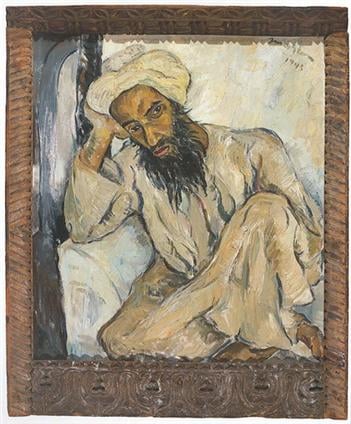
Irma Stern’s Arab Priest stands as a compelling example of early 20th-century Post-Impressionist portraiture, and its significance lies in how the artist uses vibrant, expressive color and bold composition to elevate a culturally specific subject into a universal statement of human dignity.
Stylistic Significance within Post-Impressionism
Stern, a South African modernist trained in Germany, absorbed the lessons of Post-Impressionism—especially the emotive power of color championed by Gauguin and van Gogh, and the simplified, sculptural forms of Cézanne. In Arab Priest, she applies these lessons to a non-European subject, breaking from the tradition of depicting such figures as ethnographic curiosities. Instead, her thick, gestural brushwork and saturated, almost Fauvist palette (deep blues, rich ochres, warm whites) convey inner life and spiritual gravitas. The priest’s face is modeled not through subtle chiaroscuro but through patches of intense color, a technique that prioritizes emotional resonance over literal description.
Cultural and Historical Significance
What makes this work particularly important is Stern’s insistence on portraying Arab, African, and other marginalized communities with unapologetic presence and psychological depth. In the context of 1920s–1930s South Africa, where racial hierarchies were rigidly enforced by law and custom, Stern’s choice to center an Arab religious leader—likely encountered during her travels to Zanzibar or the Swahili coast—was a quiet but radical act. She does not exoticize or sentimentalize him; the priest’s direct gaze, closed lips, and upright posture suggest authority, contemplation, and self-possession. This challenges the era’s colonial gazes and asserts the humanity and complexity of her sitters.
Artistic Achievement
The portrait’s power also lies in its formal economy. The priest’s white robes and headdress anchor the composition, while the dark background forces attention onto his face and hands—the traditional instruments of blessing and prayer. Stern’s decision to leave the background almost abstract allows the viewer to focus on the sitter’s expression, which is neither submissive nor aggressive but meditative. This balance between specificity (the priest’s cultural markers) and universality (the shared human experience of faith and introspection) is a hallmark of Stern’s best work.
In sum, Arab Priest is significant not only as a vivid example of Post-Impressionist portraiture but also as a pioneering work that redefined who could be the subject of serious modern art. Irma Stern used the language of European modernism to grant presence and dignity to figures too often rendered silent by history, making this portrait a quiet monument to cross-cultural empathy and artistic bravery.
Genere
Stile
Visivamente simili
20 opere con composizione e palette affini
The Rich Old Arab
Irma Stern
Arab
Irma Stern
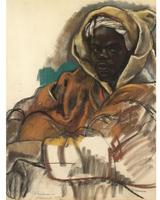
Portrait of a young man, Marrakech
Zinaida Serebriakova
Pasha
Jean-Honore Fragonard
Jacob weeps over Joseph's tunic
Marc Chagall
Portrait
Mahmud Taghiyev
Old Jew
Alexander Bogen
Job in despair
Marc Chagall
Head of I. I. Levitan turned like the head of Christ in the "Dream"
Vasily Polenov
Turk Bargainer
Constantin Artachino
Untitled
Chronis Botsoglou
The Old King
Georges Rouault
Turks from Mangalia
Iosif Iser
A Hindu Mystic
N.C. Wyeth
Fatma (II)
Henri Matisse
Moroccan in Green
Zinaida Serebriakova
Turk
Constantin Artachino
The Baluch
Morteza Katouzian
Almond Bargainer
Constantin Artachino
Arab Boy
Konstantin Makovsky