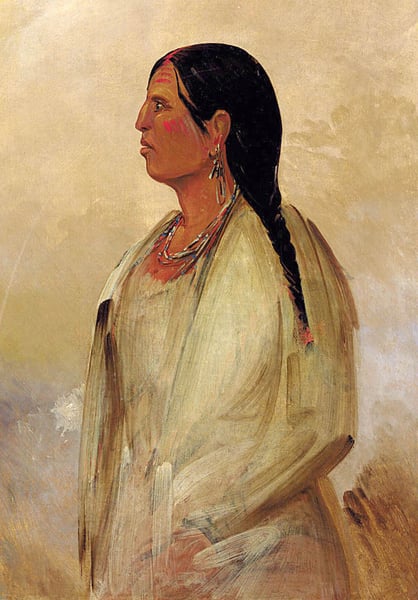
Expert analysis of George Catlin’s A Choctaw Woman
Style: Realism · Genre: portrait
Expert Analysis: "A Choctaw Woman" by George Catlin
George Catlin’s A Choctaw Woman is a compelling example of 19th-century American Realism, distinguished not merely by its technical fidelity but by its role as a vital ethnographic document. Painted during Catlin’s travels through the American frontier (1830s–1840s), the work belongs to his celebrated “Indian Gallery”—a monumental series intended to preserve the likenesses and customs of Native peoples threatened by forced removal and assimilation.
Significance within Realism and its Period:
While Catlin lacked formal academic training, his commitment to direct observation aligns with Realist principles. He painted subjects from life, prioritizing accurate skin tones, textiles, and adornments over romanticized idealization. In A Choctaw Woman, this manifests in the careful rendering of the subject’s traditional dress, jewelry, and hairstyle—details that provide anthropological data alongside aesthetic appeal. The sitter’s direct, dignified gaze defies contemporary stereotypes of the “noble savage” or tragic victim, instead asserting individual presence and agency.
Cultural and Historical Importance:
The portrait captures a specific moment in Choctaw history. Painted just after the 1830 Indian Removal Act—which forced the Choctaw Nation on the Trail of Tears—the image becomes a rare, empathetic record of a people in crisis. Catlin’s choice to name the work by her tribal affiliation, rather than a generic title, underscores his objective: to honor distinct cultural identities. The woman’s calm expression and composed posture subtly resist the narrative of erasure, offering a visual testimony of resilience.
Artistic Legacy:
Unlike many contemporary portraitists who depicted Native Americans as exotic curiosities, Catlin’s realism here serves a documentary purpose. His work influenced later artists like Edward Curtis and remains a cornerstone for scholars studying pre-assimilation Native dress, ornamentation, and bearing. A Choctaw Woman thus transcends its genre as a portrait, becoming a bridge between art history and ethnography—a quiet, powerful witness to a culture that refused to vanish from the American landscape.
Visually similar
20 works with related composition and palette
Indian Girl
Aleksander Belyaev
Gypsy Woman with Red Scarf
Octav Bancila
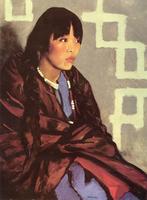
Indian Girl of San Ildefonso
Robert Henri
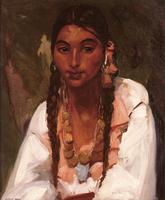
Gypsy Girl in White
Robert Henri
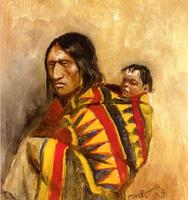
Stone-in-Moccasin Woman
Charles M. Russell
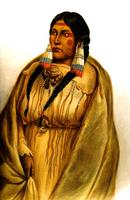
Woman of The Cree Tribe
Karl Bodmer
Hól-te-mál-te-téz-te-néek-ee, Sam Perryman (Creek Chief)
George Catlin
Macedonia
Robert Henri
Dacota Woman and Assiniboin Girl, plate 9 from volume 2 of `Travels in the Interior of North America'
Karl Bodmer
Woman of the Snake tribe and woman of the Cree tribe, plate 33 from Volume 1 of 'Travels in the Interior of North America'
Karl Bodmer
Indian Buck
Charles M. Russell
The Flower Girl
Nicolae Vermont
Indian
Jaroslav Čermák
Sha-kó-ka (mint), a Mandan girl
George Catlin
The gypsy woman
Felice Casorati
Mó-sho-la-túb-bee, He Who Puts Out and Kills, Chief of the Tribe
George Catlin
The Chief
Aleksander Belyaev
Young Buck of the Tesuque Pueblo
Robert Henri
Indian Squaw
Charles M. Russell
Piegan Blackfeet girl
Karl Bodmer