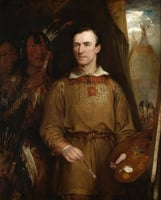
Expert analysis of George Catlin’s The White Cloud, Head Chief of the Iowa
Style: Realism · Genre: portrait
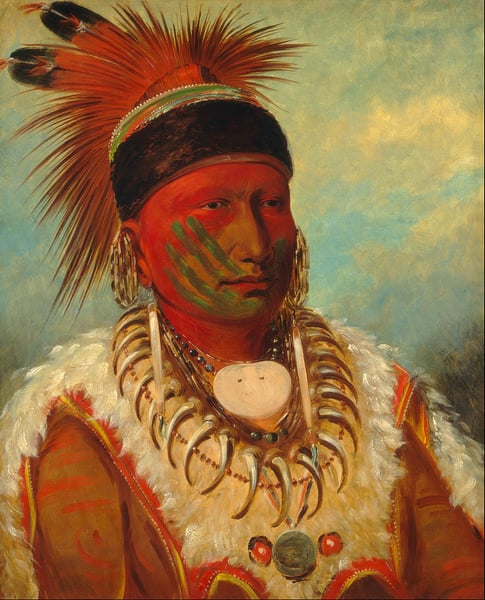
Expert Analysis: "The White Cloud, Head Chief of the Iowa" by George Catlin
As a work of Realism and a portrait, George Catlin’s "The White Cloud, Head Chief of the Iowa" stands as a significant document of both artistic and ethnographic history. Catlin was a pioneering American painter who dedicated his career to recording the lives, leaders, and customs of Native American tribes during a period of rapid displacement and cultural change.
Significance within Realism:
In the context of 19th-century Realism—a movement that sought to depict subjects with fidelity to observable fact, avoiding idealization—Catlin’s portrait is notable for its unflinching, straightforward representation. The artist does not romanticize or monumentalize the sitter in a European classical manner; instead, he captures the chief's individual features, attire, and bearing with a documentary precision. The realistic rendering of details—from the texture of the feathered headdress to the lines on the chief’s face—serves both as a lifelike likeness and as a visual record of cultural markers (such as ceremonial paint, jewelry, and clothing). This commitment to accuracy aligns with Realism’s broader aim to portray contemporary life and people without mythological or allegorical embellishment.
Significance as a Portrait:
As a portrait, the work goes beyond mere likeness to assert the dignity, authority, and humanity of its subject. "The White Cloud" is not depicted as a stereotype or a passive figure; his posture is direct, his gaze meets the viewer, and his regalia is presented with the same respect as a European nobleman’s attire would be in a formal portrait. In this way, Catlin’s portrait challenges the prevailing attitudes of his era by elevating an Indigenous leader to the status of a worthy and autonomous individual. The title itself—"Head Chief of the Iowa"—grounds the image in a specific political and social identity, reinforcing the subject’s agency.
Broader significance:
Catlin’s entire oeuvre, of which this portrait is a part, is historically crucial because it preserves visual evidence of Native American leaders and cultures at a time when westward expansion was erasing them. "The White Cloud, Head Chief of the Iowa" thus functions as both an artwork and an anthropological document, typical of Catlin’s mission to create a "gallery of Indian faces." Its significance lies in the intersection of artistic realism and cultural preservation: a truthful, humanizing depiction that grants lasting visibility to a leader and a people.
Visually similar
20 works with related composition and palette
See-non-ty-a, an Iowa Medicine Man
George Catlin
Buffalo Bull's Back Fat (Stu-mick-o-súcks) Head Chief of the Blood Tribe (Blackfoot)
George Catlin
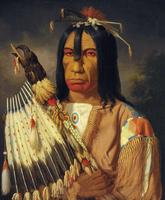
The Man That Gives the War Whoop
Paul Kane
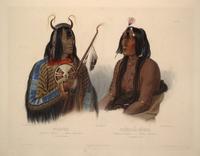
Noapeh, an Assiniboin Indian and Psihdja-Sahpa, a Yanktonan Indian, plate 12 from Volume 2 of 'Travels in the Interior of North America'
Karl Bodmer
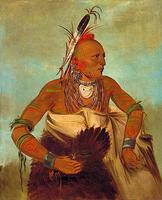
Osage warrior of the Wha-sha-she band (a subdivision of Hunkah)
George Catlin
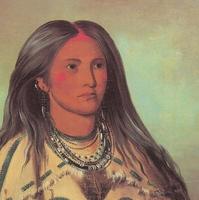
Sha-kó-ka (mint), a Mandan girl
George Catlin
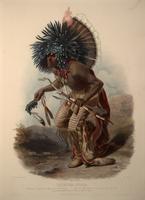
Pehriska-Ruhpa, Minatarre Warrior in the Costume of the Dog Dance, plate 23 from Volume 2 of 'Travels in the Interior of North America'
Karl Bodmer
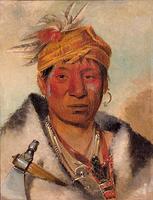
Ah-yaw-ne-tak-oár-ron, a Warrior
George Catlin
Mandan indians
Karl Bodmer
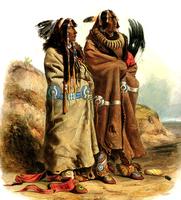
Sih-Chida and Mahchsi-Karehde, Mandan Indians, plate 20 from Volume 2 of 'Travels in the Interior of North America'
Karl Bodmer
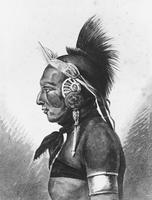
An Osage Warrior
Pavel Svinyin
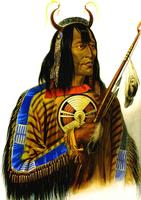
Noapeh Assiniboin Indian
Karl Bodmer
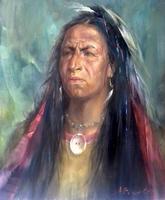
The Chief
Aleksander Belyaev
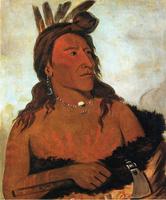
Little Bear, Hunkpapa Brave
George Catlin
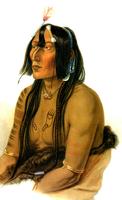
Psihdja Sahpa, Yanktonian Indian
Karl Bodmer
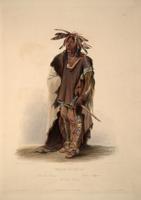
Wahk-Ta-Ge-Li, a Sioux Warrior, plate 8 from Volume 2 of 'Travels in the Interior of North America'
Karl Bodmer
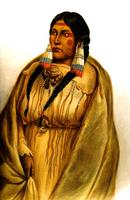
Woman of The Cree Tribe
Karl Bodmer
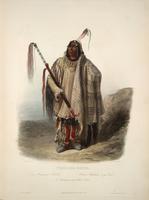
A Minatarre or Big bellied indian, plate 17 from Volume 2 of 'Travels in the Interior of North America'
Karl Bodmer
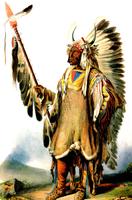
Mato Tope Mandan Chief
Karl Bodmer
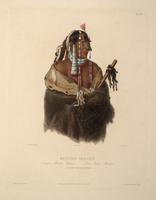
Mándeh Páhchu, a Young Mandan Indian, plate 24 from Volume 1 of 'Travels in the Interior of North America'
Karl Bodmer