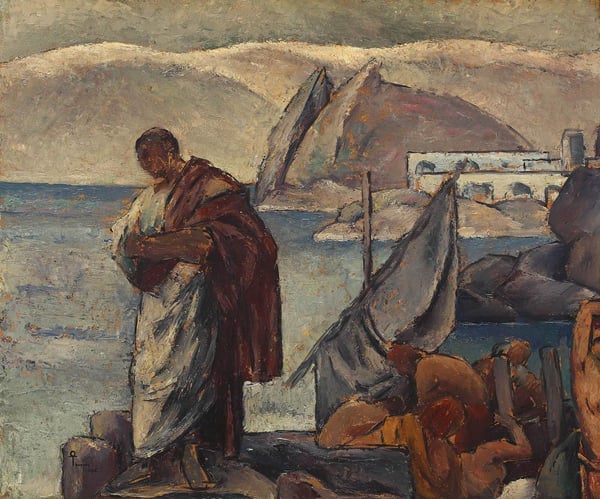
Analisi esperta di Ovid in Exile di Ion Theodorescu-Sion
Stile: Post-Impressionism · Genere: literary painting
Artwork Analysis: "Ovid in Exile" by Ion Theodorescu-Sion
Context and Style
Ion Theodorescu-Sion (1882–1939) was a Romanian modernist whose work bridged Symbolism, Post-Impressionism, and early Expressionism. Ovid in Exile (c. 1907–1910) exemplifies his Post-Impressionist phase—a style that, in Eastern Europe, often carried a heightened emotional and symbolic intensity, drawing on French models (Cézanne, Gauguin, Van Gogh) while grappling with national identity and historical memory.
Significance as a Literary Painting
The work takes its subject from the Roman poet Ovid, banished by Augustus to Tomis (modern Constanța, Romania) in 8 CE. By choosing this theme, Theodorescu-Sion aligns himself with a long tradition of literary painting while injecting a distinctly Romanian perspective: Tomis is on the Black Sea coast, making Ovid’s exile a local, almost national, myth. The painting thus functions as a meditation on displacement, memory, and the role of the artist in a hostile world—themes that resonated deeply in early 20th-century Romanian culture, then emerging from Ottoman influence toward modern European identity.
Post-Impressionist Execution and Innovation
- Color and Mood: Theodorescu-Sion employs a palette typical of Post-Impressionism—muted earth tones broken by patches of ochre, deep blue, and dull green. Unlike the luminous landscapes of the French plein-air painters, his colors are somber, almost funereal, evoking the desolation of the Pontic steppes. The contrast between Ovid’s Roman red clothing and the grey-blue landscape underscores the poet’s alien status.
- Brushwork and Form: The canvas is built from short, visible strokes (reminiscent of Van Gogh) that coalesce into a rough, almost tactile surface. The sky is rendered in concentric, swirling patterns—a hallmark of Post-Impressionist emotional expression—suggesting the turbulence of Ovid’s internal exile. Figures are flattened, with simplified contours that forgo classical proportion in favor of expressive distortion.
- Composition: Ovid is placed off-center, hunched and staring outward, while the background dissolves into abstracted clumps of vegetation and sky. This asymmetry emphasizes psychological isolation. The lack of a clear horizon line further destabilizes the viewer, mirroring Ovid’s own disorientation.
What Makes It Significant
- Hybrid Narrative: Theodorescu-Sion fuses a canonical Western literary subject (Ovid’s Tristia) with a local landscape and a Post-Impressionist formal language, creating a work that is neither purely illustrative nor purely decorative. It stands as an early example of how Eastern European modernists used Western techniques to reclaim regional history.
- National Allegory: For Romanian audiences, Ovid’s exile resonated as a metaphor for the condition of the artist-intellectual in a society still grappling with modernization. The painting predates the Symbolist-Expressionist turn in Romanian art, yet already contains its seeds.
- Mastery of Mood: Within Post-Impressionism, which often emphasized joy, primitivism, or decorative harmony, Theodorescu-Sion’s somber, introspective handling of the exile theme expands the movement’s emotional range. The work demonstrates that Post-Impressionism could serve as a vehicle for historical pain as effectively as for modern leisure or rural idyll.
Conclusion
Ovid in Exile is significant because it marries a classical literary narrative with the radical formal innovations of Post-Impressionism, while grounding both in a specific national context. It exemplifies how Eastern European artists reimagined Western movements to articulate their own cultural and historical preoccupations—making the painting not just a depiction of an ancient poet, but a portrait of modern artistic alienation.
Visivamente simili
20 opere con composizione e palette affini
Tiberius Exiles
Felix-Joseph Barrias
The limits of Tyre
Vasily Polenov
Christ Calling the Apostles James and John
Edward Armitage
Alexander and Bucephalus (detail)
Edgar Degas
The Departure
Odilon Redon
Cincinnatus Recevant Les Députés Du Sénat
Felix-Joseph Barrias
Christ Walks on Water
Eero Järnefelt
Homer: Epic Poetry
Pierre Puvis de Chavannes
Follow me, Satan (Temptation of Jesus Christ)
Ilya Repin
The Etruscan armourer
Federico Faruffini
Lost Illusions
Charles Gleyre
The Song of the Shepherd
Pierre Puvis de Chavannes
John and James
Vasily Polenov
Temptation of Christ
Ilya Repin
The Miraculous Draught
Henri-Pierre Picou
Peter Walks on Water
Philipp Otto Runge
Beggar (sketch)
Henryk Siemiradzki
Regreso del hijo pródigo
Julio Romero de Torres
The Styx--Philippo Argenti
Gustave Dore
Cry of prophet Jeremiah on the Ruins of Jerusalem (on a Bible subject)
Ilya Repin