Expert analysis of Fritz Glarner’s Relational Painting #9
Style: Neoplasticism · Genre: abstract
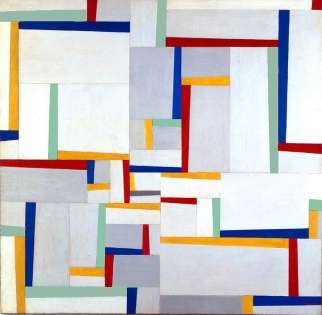
Expert Analysis of "Relational Painting #9" by Fritz Glarner
Artwork: "Relational Painting #9" | Artist: Fritz Glarner | Style: Neoplasticism | Genre: Abstract
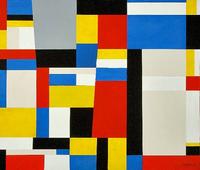
Fritz Glarner’s "Relational Painting #9" stands as a quintessential example of Neoplasticism, the rigorous abstract movement founded by Piet Mondrian and Theo van Doesburg. Within this style, Glarner is distinguished for his personal evolution of the idiom—what he termed “relational painting.” This work, part of a numbered series, demonstrates his commitment to the Neoplasticist core principles: the reduction of form to orthogonal lines, flat planes of primary color (red, blue, yellow), and the use of black, white, and gray, all arranged in a dynamic yet balanced composition.
What makes Relational Painting #9 significant is how it extends Mondrian’s legacy while introducing a distinctive density and asymmetry. Glarner’s “relational” approach focused on the interplay between rectangular planes—not merely as static blocks, but as elements that create a rhythmic push-and-pull across the canvas. The composition likely employs overlapping and abutting rectangles, creating a more complex grid than Mondrian’s classical compositions, yet still adhering to Neoplasticism’s rejection of representation.
By integrating subtle shifts in scale and placement, Glarner achieved a sense of movement without breaking the strict orthogonality of the style. This painting embodies the movement’s ideal of a universal visual language, where pure geometry expresses harmony and order. Glarner’s series, including Relational Painting #9, is crucial for demonstrating that Neoplasticism could evolve beyond its founding figures, proving its adaptability and enduring influence on mid-20th-century abstraction.
Visually similar
20 works with related composition and palette
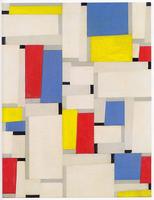
Relational Painting
Fritz Glarner
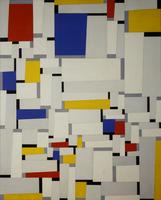
Relational Painting
Fritz Glarner
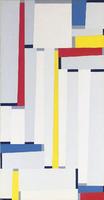
Relational Painting #55
Fritz Glarner
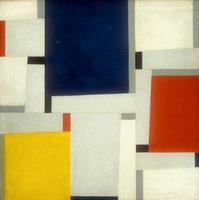
Relational Painting #64
Fritz Glarner
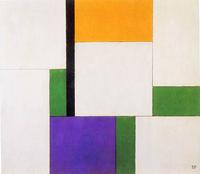
Composition
Georges Vantongerloo
Cunard L-8-62
Conrad Marca-Relli
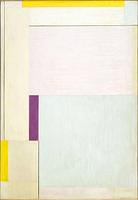
Violet Rectangle
Ilya Bolotowsky
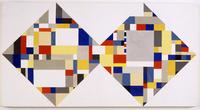
Double Diamond
Ilya Bolotowsky
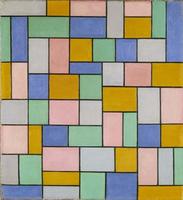
Composition in dissonances
Theo van Doesburg
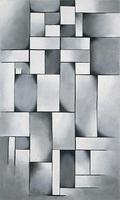
Composition in gray (Rag Time)
Theo van Doesburg
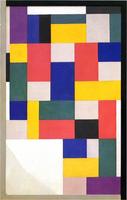
Pure Painting
Theo van Doesburg
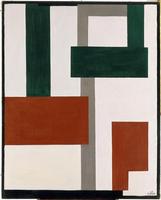
Mural
Fernand Leger
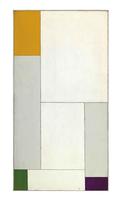
Composition émanante de l'équation y=-ax2+bx+18 avec accord de l'orangé-vert-violet
Georges Vantongerloo
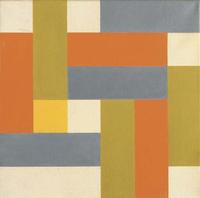
Farbenergien in vier Richtungen
Richard Paul Lohse
Untitled
Bart van der Leck
Peinture murale (Mural Painting)
Fernand Leger
Relational Painting #65
Fritz Glarner
Composition néo-plastique 5a
Cesar Domela
Untitled
John McLaughlin
Simultaneous Composition XXIV
Theo van Doesburg